

If you are looking for a country that starts with Y, there is only one current sovereign United Nations member state whose standard English name begins with the letter Y:
Yemen.
Officially known as the Republic of Yemen, the country is located in Western Asia at the southern end of the Arabian Peninsula.
The United Nations Member States directory contains only one country under Y: Yemen.
Yemen is the only sovereign UN member state whose standard English name starts with the letter Y.
How Many Countries Start With Y?
There is exactly one sovereign country beginning with Y: Yemen.
| # | Country | Official Name | Capital | Region | ISO Codes |
|---|---|---|---|---|---|
| 1 | Yemen | Republic of Yemen | Sana’a | Western Asia | YE / YEM |
The United Nations geographical names database records Yemen as the English short name and the Republic of Yemen as its formal English name. It classifies Yemen within Asia and specifically Western Asia.
So for a geography quiz, school assignment, alphabetical puzzle, or country-name list, the answer is straightforward:
Yemen is the only country that starts with Y.
Facts About Yemen
| Fact | Yemen |
|---|---|
| Official name | Republic of Yemen |
| Arabic name | اليمن |
| Romanized Arabic name | Al Yaman |
| Capital | Sana’a |
| Region | Western Asia |
| Continent | Asia |
| Currency | Yemeni Rial |
| Currency code | YER |
| ISO Alpha-2 | YE |
| ISO Alpha-3 | YEM |
| Modern unification | May 22, 1990 |
| UNESCO World Heritage properties | 5 |
United Nations statistical data lists Sana’a as Yemen’s capital and the Yemeni Rial as its currency.
Where Is Yemen?
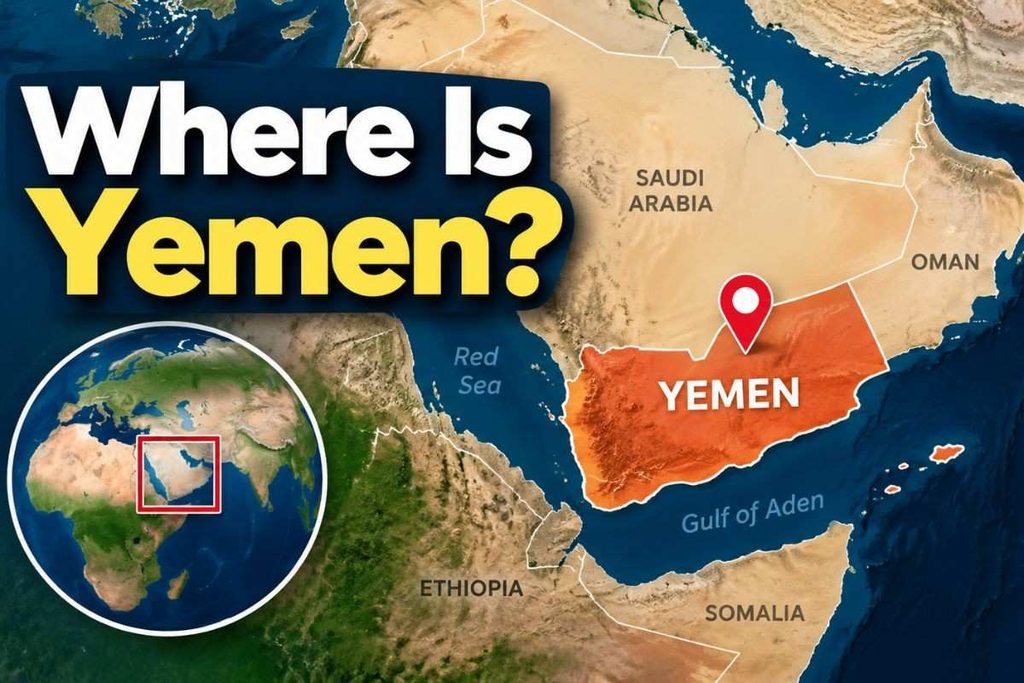
Yemen lies at the southwestern edge of the Arabian Peninsula in Western Asia.
It borders:
- Saudi Arabia to the north
- Oman to the east
- the Red Sea to the west
- the Gulf of Aden and Arabian Sea to the south
Its position places Yemen close to one of the world’s major maritime corridors linking the Red Sea with the Gulf of Aden and the wider Indian Ocean.
Yemen’s geography is far more varied than the word “desert” suggests.
Its landscapes include:
- rugged western mountains
- high plateaus
- coastal plains
- desert and semi-desert regions
- deep valleys
- agricultural terraces
- Red Sea islands
- the Socotra Archipelago
Why Is Yemen the Only Country That Starts With Y?
There is no geographic rule that determines which letters begin country names.
Modern English country names developed through different languages, political histories, translations, dynasties, geographic terms, colonial-era conventions, and international naming standards.
The result is that some letters are far more common than others.
Y is one of the rarest.
Yemen is the only current sovereign UN member under Y.
It is similar to Q, where Qatar is the sole sovereign country represented by that letter, and O, where Oman stands alone in the modern country list.
Some letters produce no sovereign-country answer at all. Our guide to the unusual situation under W explains why places such as Wales and Western Sahara do not create a UN-member W country.
Other letters produce larger groups. Jamaica, Japan, and Jordan form the J group, while Fiji, Finland, and France make up the F list.
The contrast becomes even clearer with the eight sovereign countries currently found under E.
Alphabetical naming is not always straightforward either. As our D-country comparison shows, formal and common country names can sometimes change where a state appears in an alphabetical list.
With Y, however, there is little ambiguity:
Yemen is the only answer.
What Is Yemen Called in Arabic?
Yemen’s Arabic short name is:
اليمن
The United Nations romanizes this as Al Yaman.
Its formal Arabic name is:
الجمهورية اليمنية
or Al Jumhūrīyah al Yamanīyah, meaning the Republic of Yemen.
What Is the Capital of Yemen?
The capital of Yemen is Sana’a.
There is, however, an important modern political distinction.
Because of Yemen’s prolonged conflict, the internationally recognized Government of Yemen has operated from Aden, while Sana’a has remained under Houthi control.
Sana’a is Yemen’s capital. Aden has served as the seat of the internationally recognized government during the conflict.
Sana’a: One of the World’s Great Historic Cities
Sana’a is not only Yemen’s capital. Its old city is also one of the country’s most distinctive historic landscapes.
UNESCO states that the Old City of Sana’a has been inhabited for more than 2,500 years and lies in a mountain valley approximately 2,200 meters above sea level.
The city is famous for its multi-storey tower houses.
These buildings combine:
- rammed earth
- fired brick
- stone
- white gypsum decoration
- geometric patterns
- traditional vertical construction
The skyline is punctuated by mosques and minarets, while gardens are interspersed among the dense urban fabric.
UNESCO inscribed the Old City of Sana’a on the World Heritage List in 1986.
A Short History of Yemen
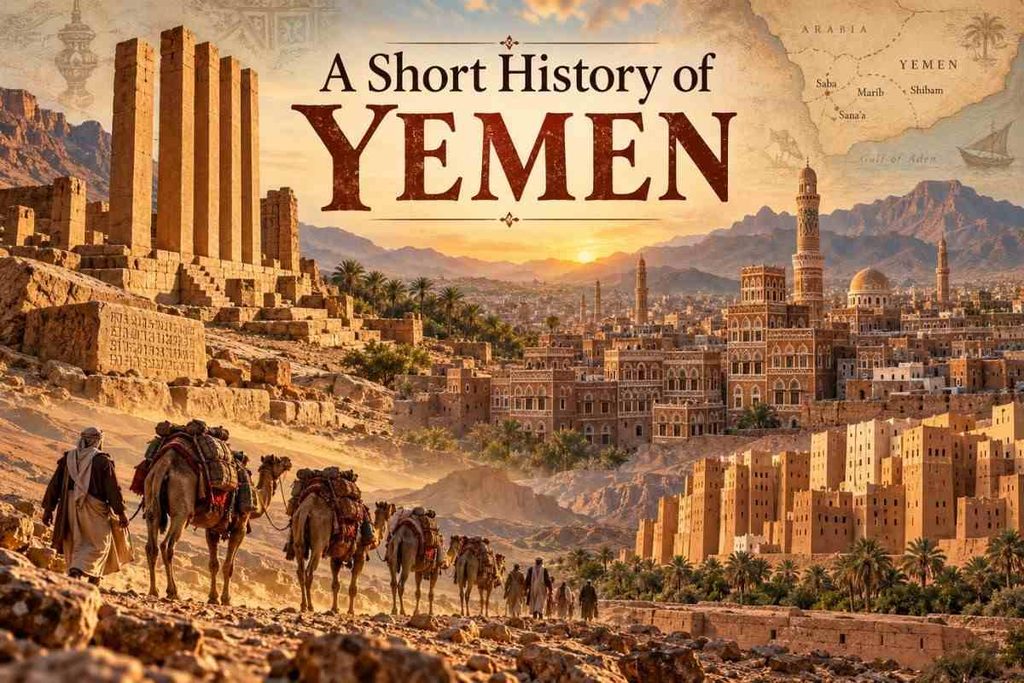
Yemen’s modern political state dates to 1990, but human civilization in southern Arabia is far older.
The territory of present-day Yemen was home to some of the ancient Arabian Peninsula’s most important kingdoms and trading societies.
1. Ancient South Arabia
Among the best-known ancient kingdoms associated with Yemen was the Kingdom of Saba, often rendered as Sheba in older traditions.
Saba became wealthy partly because of its role in long-distance trade.
UNESCO describes the ancient kingdom as an important power connected with the incense trade route between southern Arabia, the Mediterranean world, and East Africa.
The civilization also developed remarkable systems for managing scarce water resources.
Around Marib, sophisticated irrigation works supported intensive agriculture and helped create a major artificial oasis.
2. Yemen and the Incense Trade
Southern Arabia occupied an important geographic position in the movement of valuable aromatics such as frankincense and myrrh.
Caravan routes connected production areas with markets farther north, while ports linked Arabia with East Africa and the Indian Ocean.
Control of these trade routes contributed to the wealth and influence of ancient Yemeni kingdoms.
3. The Arrival of Islam
Islam reached Yemen during the seventh century.
Sana’a became an important center of Islamic political, religious, and cultural life.
UNESCO notes that the city became a major center for the spread of Islam during the seventh and eighth centuries.
Over succeeding centuries, different dynasties and political powers controlled parts of Yemen.
North Yemen and South Yemen
One of the most important facts for understanding modern Yemen is that today’s republic developed from two previously separate states.
The northern and southern parts of Yemen followed different political paths during the 19th and 20th centuries.
Northern Yemen was influenced by the Ottoman Empire, while Britain captured Aden in 1839 and developed a strong presence in southern Yemen.
The political division eventually produced:
- the Yemen Arab Republic in the north
- the People’s Democratic Republic of Yemen in the south
The two states had separate governments and international relationships before unification.
When Did Yemen Become One Country?
Modern Yemen was unified on May 22, 1990.
On that date, the Yemen Arab Republic and the People’s Democratic Republic of Yemen merged to create the Republic of Yemen.
United Nations treaty records state that the two countries would merge into a single sovereign state called the Republic of Yemen, with Sana’a as its capital.
May 22 is therefore a crucial date in the history of the modern Yemeni state.
When Did Yemen Join the United Nations?
This question is more interesting than it first appears.
The United Nations records Yemen’s membership date as September 30, 1947.
However, that date relates to the earlier northern Yemeni state.
Democratic Yemen, representing the southern state, was admitted separately on December 14, 1967.
When the two states merged on May 22, 1990, they continued as one UN member under the name Yemen rather than entering the organization as an entirely new member.
| Event | Date |
|---|---|
| Yemen admitted to UN membership | September 30, 1947 |
| Democratic Yemen admitted separately | December 14, 1967 |
| North and South Yemen unify | May 22, 1990 |
| Unified state represented as Yemen | From May 22, 1990 |
Yemen’s UNESCO World Heritage Sites
As of 2026, Yemen has five UNESCO World Heritage properties.
- Old Walled City of Shibam
- Old City of Sana’a
- Historic Town of Zabid
- Socotra Archipelago
- Landmarks of the Ancient Kingdom of Saba, Marib
| World Heritage Site | Type | Year Inscribed |
|---|---|---|
| Old Walled City of Shibam | Cultural | 1982 |
| Old City of Sana’a | Cultural | 1986 |
| Historic Town of Zabid | Cultural | 1993 |
| Socotra Archipelago | Natural | 2008 |
| Landmarks of the Ancient Kingdom of Saba, Marib | Cultural | 2023 |
Old Walled City of Shibam
Shibam is one of Yemen’s most visually extraordinary historic cities.
Its tall mud-brick tower houses rise several storeys above the surrounding landscape.
UNESCO describes the walled city as one of the oldest and finest examples of urban planning based on vertical construction.
Its appearance has earned it the nickname “the Manhattan of the desert.”
Old City of Sana’a
The Old City of Sana’a has been inhabited for more than 2,500 years.
Its tower houses, decorated facades, mosques, gardens, and narrow streets form one of Yemen’s defining architectural landscapes.
Historic Town of Zabid
Zabid is another major historic Yemeni city.
UNESCO notes that it served as a capital of Yemen from the 13th to the 15th century and became influential in the wider Arab and Muslim world because of its Islamic university.
Socotra Archipelago
Socotra is perhaps Yemen’s most internationally recognizable natural landscape.
The archipelago lies in the northwest Indian Ocean near the Gulf of Aden.
Its long geographic isolation helped produce extraordinary levels of endemism.
According to UNESCO:
- 37% of Socotra’s plant species are found nowhere else
- 90% of its reptile species are endemic
- 95% of its land snail species occur nowhere else
The archipelago was inscribed on the World Heritage List in 2008.
Landmarks of the Ancient Kingdom of Saba, Marib
Yemen’s newest World Heritage property is the Landmarks of the Ancient Kingdom of Saba, Marib.
It was inscribed in 2023.
The property consists of archaeological sites associated with the ancient Kingdom of Saba and helps document:
- South Arabian civilization
- monumental architecture
- the incense trade
- ancient administration
- irrigation engineering
- agriculture in an arid landscape
Why Are Several Yemeni UNESCO Sites in Danger?
Yemen’s heritage has faced severe threats from conflict, deterioration, development pressure, flooding, lack of maintenance, and other conservation challenges.
As of 2026, four Yemeni cultural properties remain associated with UNESCO’s World Heritage in Danger process:
- Historic Town of Zabid
- Landmarks of the Ancient Kingdom of Saba, Marib
- Old City of Sana’a
- Old Walled City of Shibam
Why Is Socotra So Famous?
Socotra looks unlike almost anywhere else on Earth.
Its geographic isolation allowed plant and animal populations to evolve separately for long periods.
Among its most recognizable plants is the dragon’s blood tree, known for its broad, umbrella-shaped crown.
But Socotra’s importance goes much deeper than a single unusual tree.
UNESCO records exceptionally high levels of endemic:
- plants
- reptiles
- land snails
along with rich marine biodiversity.
Is Yemen in Asia or the Middle East?
Yemen is in Asia.
More precisely, the United Nations classifies Yemen as part of Western Asia.
Yemen is also commonly described as a Middle Eastern country.
- Asia is the continent
- Western Asia is the UN geographic subregion
- Middle East is a broader regional term
Yemen is a Western Asian country on the Arabian Peninsula and is commonly considered part of the Middle East.
Is Yemen Part of the Arabian Peninsula?
Yes.
Yemen occupies the southern and southwestern portion of the Arabian Peninsula.
It shares the peninsula with countries including Saudi Arabia and Oman.
Its long coastlines along the Red Sea, Gulf of Aden, and Arabian Sea have historically connected it with Africa, the Indian Ocean, and other parts of Arabia.
Is Yemen an Island Country?
No.
Most of Yemen lies on the Arabian Peninsula, so it is primarily a continental country.
However, Yemen also includes islands.
The most famous are those of the Socotra Archipelago, which lie offshore in the northwest Indian Ocean near the Gulf of Aden.
Is Yemen the Only Country Starting With Y?
Yes, under the current United Nations member-state system.
No other sovereign UN member state’s standard English short name begins with Y.
That makes Yemen one of several countries with a letter almost entirely to itself.
Does Yugoslavia Count as a Country Starting With Y?
Not today.
Yugoslavia was a historical country name, but Yugoslavia no longer exists as a sovereign state.
Different political forms of Yugoslavia existed during the 20th century, but the former state ultimately dissolved and its territory is now divided among several independent countries.
Therefore, Yugoslavia may appear in historical country lists but should not be included in a current list of countries beginning with Y.
Is Yukon a Country?
No.
Yukon is a territory of Canada.
It is located in northwestern Canada and is one of the country’s three territories.
Is Yucatán a Country?
No.
Yucatán is a state of Mexico and also gives its name to the wider Yucatán Peninsula.
It is not an independent sovereign country.
Is Yorkshire a Country?
No.
Yorkshire is a historic geographic and cultural region of England, within the United Kingdom.
Yemen vs Other Places That Start With Y
| Name | What Is It? | Current Sovereign Country? |
|---|---|---|
| Yemen | Independent state | Yes |
| Yugoslavia | Former historical state | No |
| Yukon | Canadian territory | No |
| Yucatán | Mexican state/peninsula | No |
| Yorkshire | Region of England | No |
| Yokohama | Japanese city | No |
| Yerevan | Capital of Armenia | No |
What Is the Only Capital Associated With the Y Country?
Since Yemen is the only sovereign country beginning with Y, its capital is also the only capital needed for a standard Y-country table:
Yemen → Sana’a
Do not confuse this with Yerevan, which starts with Y but is the capital of Armenia.
Frequently Asked Questions
Yemen is the only current sovereign United Nations member state whose standard English name begins with Y.
There is only one country that starts with Y: Yemen.
The only current sovereign Y country is Yemen, officially the Republic of Yemen.
The capital is Sana’a. Because of the ongoing political conflict, the internationally recognized government has operated from Aden, but UN statistics continue to list Sana’a as Yemen’s capital.
Yes. Yemen is classified by the United Nations as part of Western Asia.
Yes. Yemen is commonly considered part of the Middle East and lies on the Arabian Peninsula.
No. Modern Yemen was formed when the Yemen Arab Republic and the People’s Democratic Republic of Yemen unified on May 22, 1990.
The UN lists Yemen’s membership date as September 30, 1947. Democratic Yemen joined separately in 1967, and after unification in 1990 the two were represented as one member called Yemen.
Yemen has five UNESCO World Heritage properties as of 2026.
Yes. The Socotra Archipelago is part of Yemen and is the country’s only natural UNESCO World Heritage property.
Not in a current country list. Yugoslavia was a historical state that no longer exists.
No. Yukon is a territory of Canada.
Final Remarks
There is only one current sovereign country whose standard English name starts with Y: Yemen.
Officially called the Republic of Yemen, it lies in Western Asia at the southern end of the Arabian Peninsula.
Its capital is Sana’a, its ISO codes are YE and YEM, and the modern unified Republic of Yemen was established on May 22, 1990 when North Yemen and South Yemen merged.
Yet Yemen’s history reaches back far beyond the modern republic.
Ancient South Arabian civilizations such as Saba developed sophisticated cities, irrigation systems, and trade networks. Historic Sana’a, the mud-brick towers of Shibam, the scholarly town of Zabid, the archaeological remains at Marib, and the exceptional biodiversity of Socotra preserve different chapters of that history.
Names such as Yugoslavia, Yukon, Yucatán, and Yorkshire may also appear when searching for places beginning with Y, but none is another current sovereign Y country.
In one sentence: Yemen is the only current sovereign United Nations member state whose standard English name begins with Y.
Country naming, regional classification, capital information, UN membership history, and World Heritage information were reviewed against United Nations and UNESCO sources in October 2026.