

Liechtenstein and Uzbekistan are the only two doubly landlocked countries in the world. Both lack an ocean coastline, and every country sharing a land border with them is also landlocked. Reaching an ocean-connected coast by land therefore requires crossing at least two international borders.
The phrase “double landlocked countries” describes the same situation as “doubly landlocked countries.” It is a relationship between national boundaries and the coast, rather than a measure of distance from the sea.
One example sits in the European Alps. The other occupies part of Central Asia. Looking at their neighbors makes this unusual geography easier to understand.
What Does Doubly Landlocked Mean?
A landlocked country has no coastline on an ocean or an ocean-connected sea. A doubly landlocked country is surrounded entirely by other landlocked countries.
Crossing its first border takes you into another country without an ocean coast. You must cross at least one more border to enter a coastal country, then continue across that territory to reach the shore.
“Double” does not mean exactly two neighboring countries. Liechtenstein has two neighbors, while Uzbekistan has five. The defining condition is that none of those neighbors has an ocean-connected coastline.
Nor does the term describe airport connections, border controls or how many customs checks a particular shipment encounters. It describes the arrangement of sovereign territories on a map.
Which Countries Are Doubly Landlocked?
| Country | Region | All neighboring countries |
|---|---|---|
| Liechtenstein | Europe, Alpine region | Austria and Switzerland |
| Uzbekistan | Central Asia | Afghanistan, Kazakhstan, Kyrgyzstan, Tajikistan and Turkmenistan |
The government of Liechtenstein identifies both countries as the only two examples in its 2023 sustainability report. The classification becomes clear once each border is checked against the coastline of the neighboring state.
Liechtenstein: Doubly Landlocked in Europe
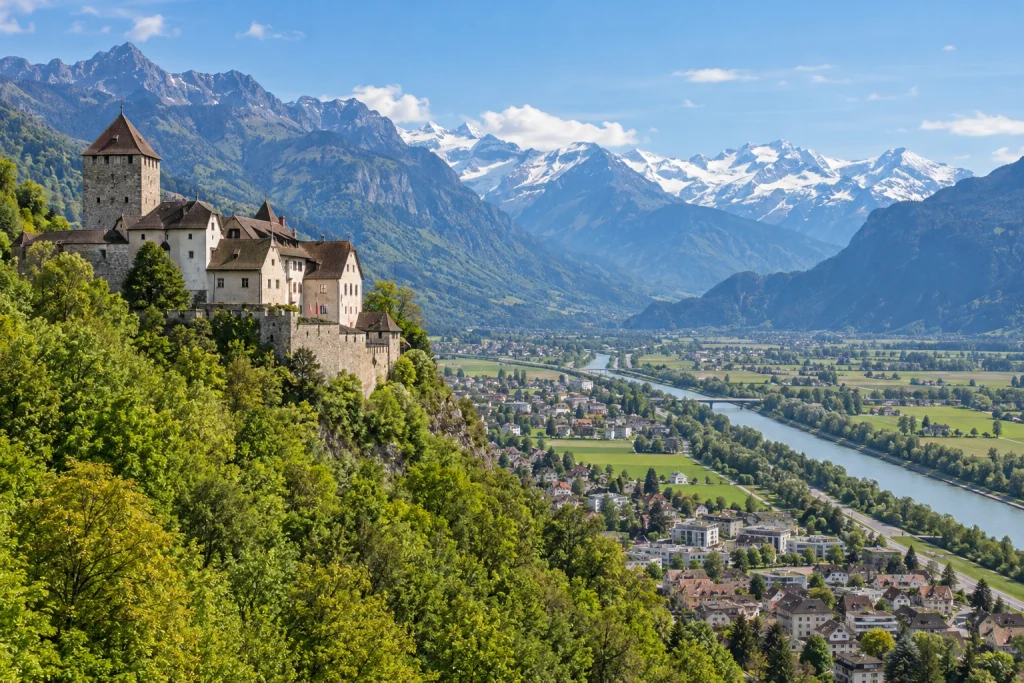
Liechtenstein lies between Switzerland and Austria in the Alpine region. It has no border with Germany or Italy, even though both appear nearby on a map of Europe.
Switzerland and Austria are each landlocked. Leaving Liechtenstein through either one therefore does not immediately put you in a coastal country.
An illustrative sequence is Liechtenstein to Austria to Italy. The first crossing enters Austria, and the second enters Italy, which has a Mediterranean coastline. Another sequence runs through Switzerland into France.
These examples count international boundaries. They do not suggest that all routes involve the same distance, roads or transport connections.
The Rhine also shows why flowing water and a national coastline are different things. It runs along the Liechtenstein–Switzerland boundary and ultimately belongs to the North Sea drainage system. Being connected to that system does not give Liechtenstein an ocean coast. Our guide to the major rivers of Europe explains the wider network.
Uzbekistan: Doubly Landlocked in Central Asia
Uzbekistan has five neighbors: Afghanistan, Kazakhstan, Kyrgyzstan, Tajikistan and Turkmenistan. Every one is landlocked.
The World Bank overview of Uzbekistan confirms both its doubly landlocked status and this complete neighbor list. Unlike Liechtenstein, Uzbekistan is surrounded by several large countries across a broad continental interior.
A simple border sequence is Uzbekistan to Afghanistan to Pakistan. Pakistan has an Arabian Sea coastline. Another is Uzbekistan to Turkmenistan to Iran, which reaches a country with ocean-connected coasts.
The examples demonstrate why the minimum is two international crossings. Actual freight movements can follow longer routes because railway connections, infrastructure, commercial arrangements and border procedures influence which corridors are used.
Uzbekistan also has rivers, despite its inland position. The Amu Darya and Syr Darya belong to the wider Aral Sea basin. Double landlocked status concerns access to the world ocean, not the absence of natural watercourses.
Why Does the Caspian Sea Not Count?
Kazakhstan and Turkmenistan both have Caspian shorelines. At first glance, that might seem to give Uzbekistan coastal neighbors.
The distinction is that the Caspian Sea is an enclosed inland body of water with no natural outlet to the world ocean. Its name does not make its shores equivalent to a Mediterranean, Atlantic or Indian Ocean coast.
Artificial canal connections do not change the conventional landlocked classification of the surrounding countries. Kazakhstan and Turkmenistan remain landlocked, so their borders do not remove Uzbekistan from the doubly landlocked group.
The Caspian also appears in our explanation of where Europe ends and Asia begins. Questions about continental boundaries and questions about ocean access describe different aspects of the same region.
Landlocked, Doubly Landlocked and Enclaved: The Difference
Several geographical conditions are easy to confuse:
| Description | Meaning | Example |
|---|---|---|
| Landlocked | No ocean-connected coastline | Hungary |
| Doubly landlocked | No ocean-connected coastline, and every neighbor is also landlocked | Liechtenstein and Uzbekistan |
| Entirely enclosed by one country | A sovereign state surrounded by a single other state | Lesotho, surrounded by South Africa |
Hungary is landlocked but borders coastal countries, including Croatia and Romania. It therefore fails the “every neighbor is landlocked” test.
Lesotho is not doubly landlocked either. Its only neighbor, South Africa, has ocean coasts. The same reasoning applies to Vatican City and San Marino, both surrounded by coastal Italy.
Enclaves concern territorial enclosure, which can also affect small possessions rather than entire countries. The history of the former Portuguese enclave at Ouidah illustrates that separate geographical question.
How Does Being Doubly Landlocked Affect Trade?
Goods moving between an inland producer and an overseas market depend on connections beyond the home country. More transit territory can mean additional coordination between transport operators, border agencies and governments.
However, counting borders alone cannot establish the cost of a journey. Reliable rail services, efficient customs procedures and access to neighboring markets may matter as much as physical distance.
The World Bank research on trade and transport in landlocked developing countries identifies transport quality, logistics costs and delays at ports and land borders as important constraints.
Liechtenstein and Uzbekistan share a geographical label, but that does not make their economic circumstances identical. The label describes their position relative to coastal states, not a fixed level of prosperity or isolation.
There are two: Liechtenstein in Europe and Uzbekistan in Central Asia. The usual geographical term is “doubly landlocked.”
No. Kazakhstan is landlocked, but it borders Russia and China, both of which have ocean-connected coastlines.
No. A country can have rivers and still be doubly landlocked. Our guide to countries without permanent rivers examines a different physical characteristic.
No. Africa has landlocked countries, but none is surrounded exclusively by other landlocked countries.

