

Europe has 14 countries in a core landlocked list: Andorra, Austria, Belarus, Czechia, Hungary, Liechtenstein, Luxembourg, Moldova, North Macedonia, San Marino, Serbia, Slovakia, Switzerland and Vatican City. Kosovo is also geographically landlocked and lies in Europe, but its statehood is not universally recognized, so it is clearer to treat it separately. Include Kosovo and the broader total becomes 15.
The coastline test itself is simple: a landlocked country has no territorial coastline giving it direct access to the world ocean or an ocean-connected sea. The harder question is deciding what counts as Europe, especially around the Caucasus and Kazakhstan.
Landlocked Countries in Europe at a Glance
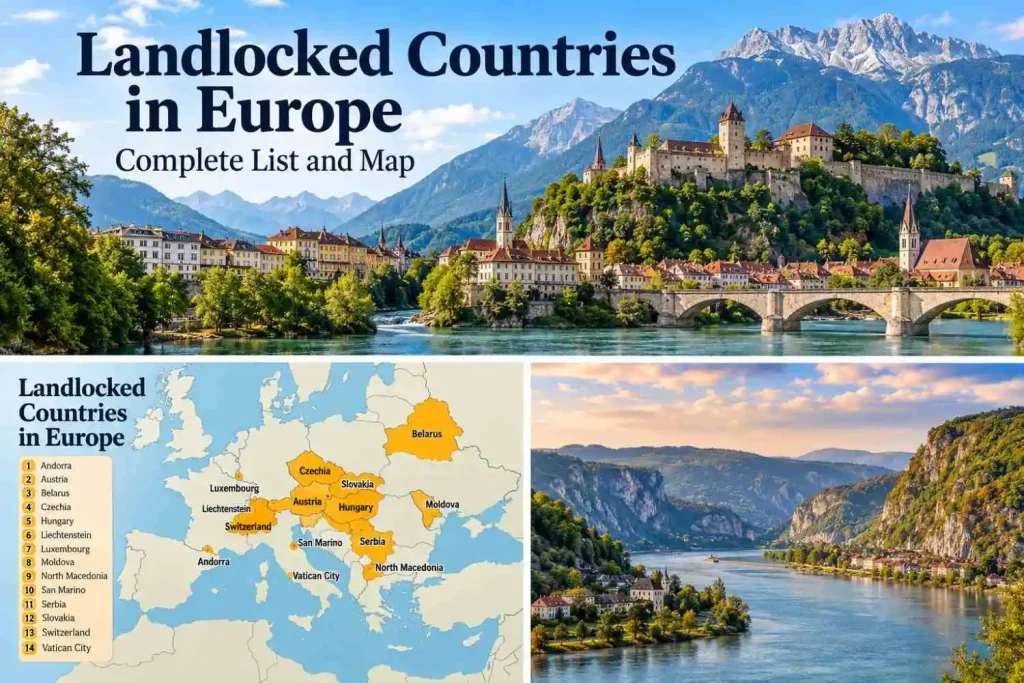
The table uses a core-Europe definition aligned with the UN M49 geographic placement of European states. It includes Vatican City as the sovereign territorial microstate and treats Kosovo separately.
| Country | Capital | Borders | EU Member? | Geographic Distinction |
|---|---|---|---|---|
| Andorra | Andorra la Vella | France, Spain | No | Pyrenean microstate between two coastal states |
| Austria | Vienna | Czechia, Germany, Hungary, Italy, Liechtenstein, Slovakia, Slovenia, Switzerland | Yes | Major Danube country with no sea coast |
| Belarus | Minsk | Latvia, Lithuania, Poland, Russia, Ukraine | No | Largest landlocked country in the core European list by area |
| Czechia | Prague | Austria, Germany, Poland, Slovakia | Yes | Watersheds ultimately drain toward the North, Baltic and Black seas |
| Hungary | Budapest | Austria, Croatia, Romania, Serbia, Slovakia, Slovenia, Ukraine | Yes | Danube and Tisza cross a landlocked Carpathian Basin state |
| Liechtenstein | Vaduz | Austria, Switzerland | No | Europe’s only double-landlocked country |
| Luxembourg | Luxembourg | Belgium, France, Germany | Yes | Small Western European landlocked state |
| Moldova | Chișinău | Romania, Ukraine | No | Landlocked despite a short Danube frontage and an international port |
| North Macedonia | Skopje | Albania, Bulgaria, Greece, Kosovo, Serbia | No | Balkan landlocked state and UN-designated LLDC |
| San Marino | San Marino | Italy | No | Landlocked enclave microstate within Italy |
| Serbia | Belgrade | Bosnia and Herzegovina, Bulgaria, Croatia, Hungary, Montenegro, North Macedonia, Romania; Kosovo boundary treated separately | No | Danube and Sava provide major river corridors |
| Slovakia | Bratislava | Austria, Czechia, Hungary, Poland, Ukraine | Yes | Danube corridor through a landlocked EU state |
| Switzerland | Bern | Austria, France, Germany, Italy, Liechtenstein | No | Rhine corridor connects inland Switzerland toward the North Sea |
| Vatican City | Vatican City | Italy | No | World’s smallest sovereign state; landlocked enclave inside Rome |
The United Nations M49 regional framework places Armenia and Azerbaijan in Western Asia and Kazakhstan in Central Asia, while listing the core European states above within Europe. That provides a useful statistical baseline even though continental geography can use other boundary conventions.
How Many Landlocked Countries Are in Europe?
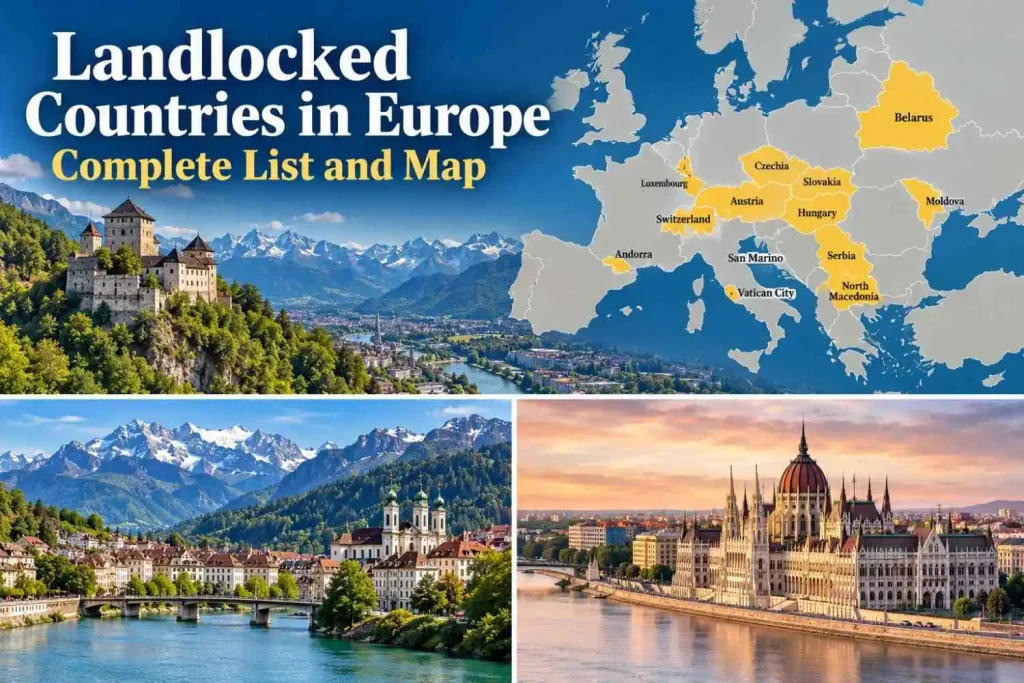
The most useful answer is:
14 in the core list; 15 if Kosovo is included.
The core 14 are broadly recognized sovereign states or sovereign territorial entities classified within Europe under the geographic framework used here.
There is another number worth knowing. Thirteen of the core 14 are United Nations member states. Vatican City State is sovereign territory, but the Holy See represents it internationally and holds non-member observer-state status at the UN. The United Nations lists the Holy See as a non-member observer state.
Kosovo creates a separate issue. Geography and diplomatic recognition are not the same question. Kosovo has no coastline, so it is geographically landlocked regardless of how individual governments treat its statehood.
That is why simply saying “Europe has 14 landlocked countries” without defining the list is less useful than explaining what the count includes.
What Does Landlocked Mean?
A landlocked state lacks a maritime coastline connected directly to the world ocean system.
That does not mean the country has no water.
A landlocked country can contain major rivers, lakes, reservoirs, canals, inland ports and international shipping routes. Austria, Hungary, Slovakia and Serbia all lie on the Danube. Switzerland connects with major Rhine and Rhône drainage systems. Moldova has a small frontage on the Danube.
None of those features creates a national sea coast.
This is also why landlocked does not mean “surrounded entirely by landlocked countries.” That rarer condition is called double-landlocked.
The 14 Landlocked Countries in Europe
1. Andorra
France and Spain border Andorra in the eastern Pyrenees. The microstate has no coastline, but both neighboring countries have direct access to the sea.
Andorra is therefore landlocked but neither an enclave nor double-landlocked.
2. Austria
Austria sits in Central Europe and borders eight countries. It has no maritime coastline, but the Danube crosses the country and creates a major international transport corridor through Central and southeastern Europe.
Austria is one of five landlocked members of the European Union.
3. Belarus
Belarus borders Latvia, Lithuania, Poland, Russia and Ukraine. It has no sea coast despite lying relatively close to both the Baltic and Black Sea drainage regions.
With a surface area of about 207,600 square kilometers, Belarus is the largest landlocked country in the 14-state core European list.
4. Czechia
Czechia sits at a major European watershed.
Its rivers ultimately drain in three broad directions: the Elbe/Labe system toward the North Sea, the Oder/Odra system toward the Baltic, and the Morava–Danube system toward the Black Sea.
The country therefore provides a good reminder that landlocked status says nothing about how many marine drainage basins a country connects to.
5. Hungary
Hungary occupies much of the central Carpathian Basin. The Danube crosses the country from north to south, while the Tisza drains a large part of eastern Hungary.
The country has substantial river transport geography despite having no coastline.
6. Liechtenstein
Liechtenstein lies between Austria and Switzerland, and both of those countries are themselves landlocked.
That makes Liechtenstein double-landlocked: reaching an ocean-connected national coastline requires crossing at least two international borders.
Liechtenstein is not an enclave because two different countries border it.
7. Luxembourg
Belgium, France and Germany border Luxembourg.
The country has no coastline and is one of Europe’s smallest sovereign states, but its landlocked geography is otherwise straightforward compared with microstates such as Liechtenstein, San Marino and Vatican City.
8. Moldova
Romania and Ukraine border Moldova, which has no sea coast.
The interesting complication is Giurgiulești. Moldova has a short stretch of Danube frontage and an international port there, giving the country access to river and seagoing shipping networks. That does not make Moldova coastal: a riverbank is not a national maritime coastline.
9. North Macedonia
North Macedonia is a landlocked Balkan state bordered by Albania, Bulgaria, Greece, Kosovo and Serbia.
Its lakes and river systems do not alter that status. It is also one of the European states classified by the United Nations as a Landlocked Developing Country, a separate development-policy category discussed below.
10. San Marino
Italy completely surrounds San Marino.
That makes San Marino both landlocked and an enclave. It is not double-landlocked because Italy has an extensive coastline.
11. Serbia
Serbia became landlocked after the dissolution of its former state union with Montenegro, leaving it without an Adriatic coast.
Its geography is still strongly connected to international waterways. The Danube crosses Serbia, and the Sava joins it at Belgrade.
12. Slovakia
Slovakia has no coastline, but the Danube runs along and through part of its southwestern geography, including Bratislava.
Like Austria and Hungary, Slovakia shows why maritime landlocked status and river connectivity should not be confused.
13. Switzerland
Switzerland is landlocked in the Alps and borders Austria, France, Germany, Italy and Liechtenstein.
The Rhine provides an important downstream corridor toward the North Sea, while the Rhône system drains toward the Mediterranean. Major lakes likewise do not make Switzerland coastal.
14. Vatican City
Italy completely surrounds Vatican City within Rome.
Vatican City is therefore a landlocked enclave and, at roughly half a square kilometer, the smallest sovereign state in the world and the smallest landlocked country in Europe.
Vatican City State and the Holy See should not be treated as interchangeable terms in every legal context. For this geographic list, Vatican City is the useful territorial label.
Does Kosovo Count as a Landlocked European Country?
Kosovo is geographically landlocked and lies in southeastern Europe.
The complication is political recognition, not physical geography.
Kosovo declared independence in 2008, but its statehood is not universally recognized and it is not a UN member. The European Union continues to use status-neutral language in contexts where member states differ on recognition; the European Commission currently lists Kosovo as a potential candidate.
For a geography article, the clearest treatment is therefore:
Core list: 14.
Kosovo included: 15.
This avoids pretending that diplomatic status changes whether a coastline exists.
Why Armenia, Azerbaijan and Kazakhstan Complicate the List
Look east on the map and the continental-boundary problem appears.
The question is no longer whether these countries are landlocked. All three lack natural access to the world ocean. The issue is whether they belong in a European country count.
Armenia
Armenia is landlocked, but the UN M49 statistical geography places it in Western Asia.
Political and cultural links with European institutions do not by themselves move the country across a physical continental boundary. This article therefore excludes Armenia from the core European count.
Azerbaijan
Azerbaijan borders the Caspian Sea, but the Caspian is an inland endorheic body of water with no natural outlet to the world ocean. Azerbaijan is therefore landlocked in the global maritime-access sense.
Its continental position is less simple. Some Caucasus boundary conventions place a small part of Azerbaijan north of the principal Greater Caucasus divide in Europe; other schemes place the country in Asia.
The UN M49 system places Azerbaijan in Western Asia, so this article treats it as a continental edge case, not a core European landlocked state. GeographicTravels’ guide to the Europe–Asia boundary explains why the Caucasus produces different answers.
Kazakhstan
Kazakhstan is the world’s largest landlocked country overall, and it also has a Caspian coastline without world-ocean access.
Most of Kazakhstan lies in Central Asia. Under the commonly used Ural River boundary, however, part of western Kazakhstan lies geographically in Europe.
That makes Kazakhstan one of the clearest transcontinental countries, but the UN M49 system classifies it in Central Asia. It is therefore excluded from the 14-country core European list.
This distinction is important when answering the “largest landlocked country in Europe” question. Kazakhstan is vastly larger than Belarus, but only part of Kazakhstan lies in geographic Europe under the Ural convention.
Which European Country Is Double-Landlocked?
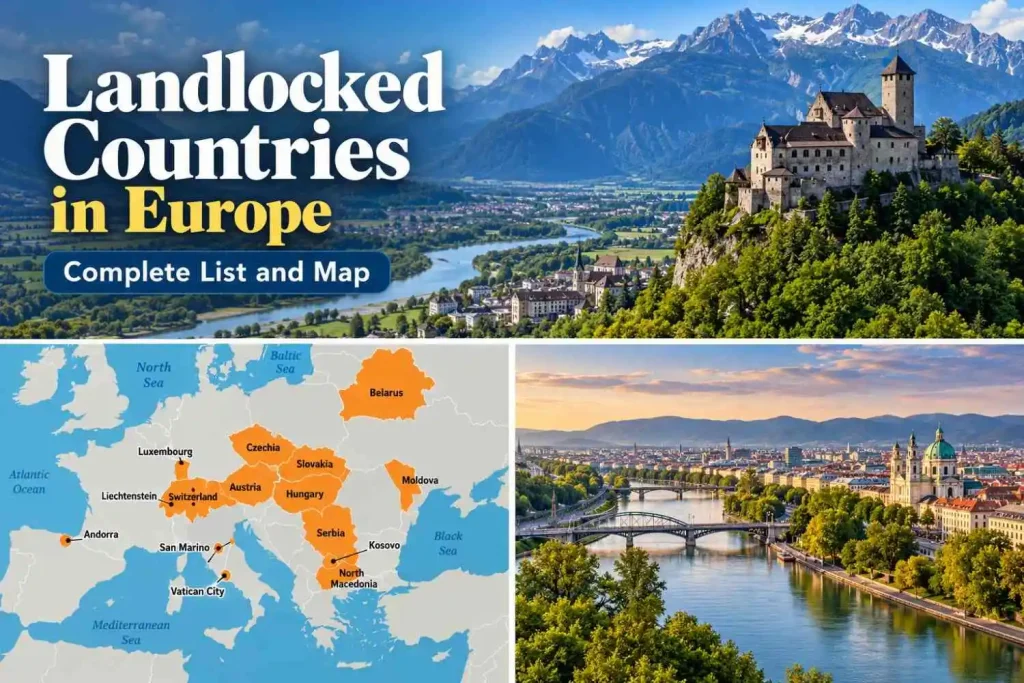
Liechtenstein is Europe’s only double-landlocked country.
Its only neighbors are Austria and Switzerland, and both are landlocked.
A route from Liechtenstein to a national coastline on an ocean-connected sea must therefore cross one neighboring country and then at least one additional country.
Globally, Liechtenstein and Uzbekistan are the two standard examples of double-landlocked sovereign states.
Which Landlocked European Countries Are Enclaves?
Two European sovereign states are both landlocked and true enclaves:
San Marino — Italy completely surrounds it.
Vatican City — Italy completely surrounds it inside Rome.
Liechtenstein is different. Austria and Switzerland border it, so it is not surrounded by one country. Its special status comes from being double-landlocked.
Andorra is different again: France and Spain border it, and both have coastlines.
Which Landlocked Countries Are in the European Union?
Five countries in the core landlocked European list are EU members:
- Austria
- Czechia
- Hungary
- Luxembourg
- Slovakia
The European Union’s current 27-member list confirms all five as member states.
Switzerland and Liechtenstein are closely integrated with parts of European economic and travel systems but are not EU members. Serbia, Moldova and North Macedonia are also not EU members, despite having formal relationships with the EU.
Geography and institutional membership answer different questions.
What Is the Largest Landlocked Country in Europe?
Belarus is the largest landlocked country in the 14-country core European list, covering about 207,600 square kilometers.
Kazakhstan makes the answer more complicated only if a transcontinental definition is used. Kazakhstan is the world’s largest landlocked country and has territory west of the Ural River under one common Europe–Asia convention, but international statistical geography places Kazakhstan in Central Asia.
So for a whole-country core-Europe ranking, Belarus is the clearer answer.
What Is the Smallest Landlocked Country in Europe?
Vatican City is Europe’s smallest landlocked country.
It is also the world’s smallest sovereign state by area. Italy completely surrounds its territory within Rome.
San Marino is much larger but remains another small landlocked enclave within Italy.
How Do Europe’s Landlocked Countries Reach the Sea?
Landlocked status affects territorial geography, not necessarily practical connectivity.
Countries can reach maritime trade networks through neighboring territory, rail and road corridors, navigable rivers, canals and downstream ports.
The Danube links Austria, Slovakia, Hungary and Serbia with the lower Danube and Black Sea system. Switzerland connects to North Sea shipping through the Rhine corridor. Czechia’s Elbe/Labe system provides another geographic connection toward the North Sea.
Moldova provides the most visually confusing example. Its Giurgiulești International Free Port stands on Moldova’s short Danube frontage. The port handles seagoing trade, but Moldova still has no sea coastline. In 2026 the EBRD described Giurgiulești as Moldova’s main maritime gateway while continuing to describe the country’s trade connectivity through the port. The port sits on the Danube, not on a Moldovan sea coast.
Several of these corridors form part of the wider river systems of Europe, particularly the Danube and Rhine.
Landlocked Does Not Mean Riverless
A country can be landlocked and still contain major rivers.
Austria, Slovakia, Hungary and Serbia sit on the Danube. Switzerland contains headwaters and reaches of major European drainage systems. Moldova borders the Danube. Czechia drains toward three different marine basins.
“Landlocked” describes the absence of a national maritime coastline.
That is a completely different geographic question from countries without permanent rivers.
Landlocked Country vs Landlocked Developing Country
A Landlocked Developing Country, usually shortened to LLDC, is a United Nations development-policy category.
It is not another definition of landlocked geography.
Under the current UN grouping, Moldova and North Macedonia are European LLDCs. Armenia, Azerbaijan and Kazakhstan are also LLDCs, but the same UN geographic framework places them in Asian regions.
Austria, Switzerland, Luxembourg and Liechtenstein are geographically landlocked but are not LLDCs.
So it would be incorrect to say that only countries on the UN LLDC list are “officially” landlocked. The LLDC label adds a development classification to a geographic condition.
Countries Often Mistaken for Landlocked
Bosnia and Herzegovina
Bosnia and Herzegovina is not landlocked.
It has a short Adriatic coastline around Neum. The coast is small enough to disappear visually on many small maps, which explains some of the confusion.
Slovenia
Slovenia is not landlocked. It has a short coastline on the Adriatic Sea.
Montenegro
Montenegro is not landlocked either. Its coastline runs along the Adriatic.
Armenia
Armenia genuinely is landlocked. The reason it is excluded from this article’s core list is its continental classification, not coastline.
Azerbaijan and Kazakhstan
Both have Caspian coastlines, but the Caspian has no natural outlet to the world ocean. They remain landlocked in the maritime-access sense.
Their exclusion from the core list comes from the Europe–Asia definition used here.
Why Do Different Websites Give Different Totals?
Several different choices can change the number.
Kosovo: include it as a landlocked European state and the 14-country core list becomes 15.
Vatican City / Holy See: some datasets use “Holy See,” while geography articles usually use Vatican City for the sovereign territory.
Armenia: some political or cultural definitions group it with Europe, while UN statistical geography places it in Western Asia.
Azerbaijan: different Caucasus boundary conventions can place part of the country in Europe.
Kazakhstan: the Ural River convention gives Kazakhstan territory in Europe, but most of the country lies in Asia and UN statistical geography places it in Central Asia.
This is why one current competitor can publish 14 while another publishes 16 without necessarily using the same definition of Europe.
The useful question is not “Which number is magically correct?” It is what definition produced the number?
The Bottom Line
Europe has 14 landlocked countries under the core geographic definition used here, or 15 if Kosovo is included.
The number becomes complicated because coastline is only one part of the classification problem. Kosovo raises recognition questions, Vatican City creates a UN-membership distinction, and Armenia, Azerbaijan and Kazakhstan depend on how Europe’s eastern boundary is defined.
The map also reveals several different kinds of landlocked geography. Liechtenstein is double-landlocked, San Marino and Vatican City are enclaves, and countries such as Austria, Hungary, Serbia, Switzerland and Moldova remain connected to maritime trade through major river and transport corridors.
A precise list therefore needs a definition before it needs a number.
Frequently Asked Questions
Europe has 14 countries in the core list used here. Kosovo is also geographically landlocked and European but is treated separately because its statehood is not universally recognized. Including Kosovo produces a broader total of 15.
They are Andorra, Austria, Belarus, Czechia, Hungary, Liechtenstein, Luxembourg, Moldova, North Macedonia, San Marino, Serbia, Slovakia, Switzerland and Vatican City.
Yes. Kosovo has no coastline, so it is geographically landlocked. This article lists it separately because its statehood is not universally recognized and it is not a United Nations member.
Liechtenstein is Europe’s only double-landlocked country. Its only neighbors, Austria and Switzerland, are also landlocked.
Belarus is the largest country in the core European list at about 207,600 square kilometers. Kazakhstan is much larger but is treated separately because it is transcontinental and classified in Central Asia by the UN M49 framework.
Vatican City is Europe’s smallest landlocked country and the world’s smallest sovereign state by area. Italy completely surrounds it within Rome.
Five EU member states are landlocked: Austria, Czechia, Hungary, Luxembourg and Slovakia.
No. Bosnia and Herzegovina has a short Adriatic coastline at Neum, so it is a coastal country.
Moldova has no sea coastline, so it remains landlocked. It does have Danube frontage and the international port at Giurgiulești, which connects the country with river and seagoing transport routes.
Armenia is landlocked, but the UN M49 geographic framework places it in Western Asia. This article therefore treats Armenia as an adjacent classification case rather than one of the core 14 European landlocked countries.