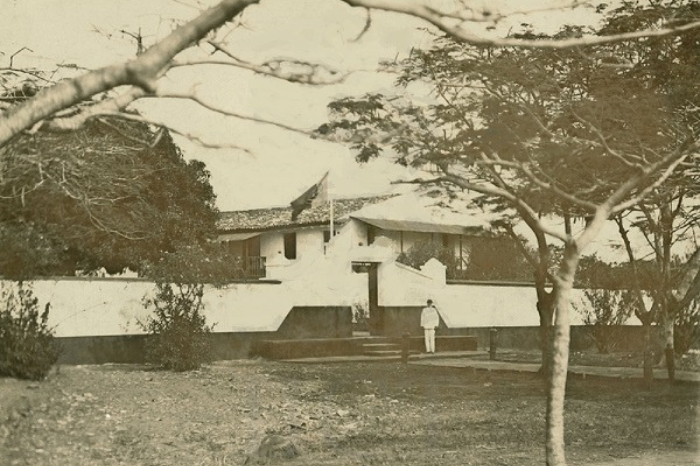
In the middle of Ouidah, in present-day Benin, stands the Fortaleza de São João Baptista de Ajudá, also known as the Fort of St. John the Baptist of Ouidah. For much of its later history, this small Portuguese possession formed an extraordinary territorial anomaly: a tiny piece of Portuguese-controlled land surrounded first by French Dahomey and later by the independent Republic of Dahomey.
For a time, São João Baptista de Ajudá was regarded as one of the smallest separate political territories in the world. It had no land connection with another Portuguese possession and sat several kilometres inland, surrounded entirely by territory controlled by another power.
Ouidah in southern Benin, where the former Portuguese enclave was located.
The Portuguese established the fort at Ouidah in 1721, during a period when European trading networks were expanding along the West African coast. Ouidah became one of the region’s most important ports, and the Portuguese fort was deeply connected to the transatlantic trade in enslaved Africans.
Its unusual geographical status developed much later. France expanded its control over Dahomey during the nineteenth century and eventually governed the land surrounding Ouidah. Portugal, however, retained São João Baptista de Ajudá. The fort was therefore left isolated inside French-controlled territory, without a corridor connecting it to another Portuguese possession.
The Portuguese Fort of São João Baptista de Ajudá in Ouidah.
By the twentieth century, the fort had little of its former commercial or military importance, yet Portugal continued to claim it. The permanent military garrison was withdrawn in 1911, and a 1921 census recorded only five inhabitants.
Dahomey gained independence from France on August 1, 1960, but the Portuguese enclave remained for another year. On August 1, 1961, Dahomey took control of the fort. Portuguese historical accounts record that the remaining Portuguese representatives were instructed to burn parts of the fort before leaving rather than formally surrender it.
With that, one of colonial Africa’s strangest geographical arrangements disappeared from the political map.
Why Was This Tiny Fort So Unusual?
European forts were once common along the West African coast. What made São João Baptista de Ajudá different was that Portugal continued to exercise sovereignty over it even after another colonial power controlled virtually everything around it.
In simple terms, it became a tiny Portuguese territorial island inside Dahomey. Its economic importance had faded, but its political symbolism survived.
Its size and population made the arrangement even stranger. Historical estimates of the enclave’s exact area vary, so there is no single measurement that should be treated as unquestioned. What is clear is that by its final decades it was exceptionally small. Academic research describes its territory as having eventually contracted to around two hectares.
And by the time Dahomey moved against the enclave in 1961, only two people remained as representatives of Portuguese sovereignty. A territorial claim associated with a European empire had effectively been reduced to a tiny compound and two officials.
A Short History of São João Baptista de Ajudá
| Year | What Happened |
|---|---|
| 1721 | The Portuguese fort is established at Ouidah. |
| 1865 | Portugal re-establishes a permanent presence at the fort after periods of decline and abandonment. |
| Late 1800s | France gains control of surrounding Dahomey while the Portuguese possession survives. |
| 1911 | Portugal withdraws the permanent military garrison. |
| 1921 | A census records only five inhabitants. |
| 1960 | Dahomey becomes independent from France. |
| 1961 | Dahomey takes control of São João Baptista de Ajudá on August 1. |
The Portuguese Fort Today
The end of the enclave did not mean the disappearance of the fort. The historic compound survived and became an important heritage site in Ouidah. It later housed the Ouidah Museum of History, while the fort itself remained closely associated with the history of the transatlantic slave trade.
That history is essential to understanding the site. UNESCO includes the Portuguese Fort among the significant places associated with the Slave Route in Benin. The surviving fort is therefore more than a curiosity left behind by an unusual border; it is also part of a much larger and more painful history linking West Africa, Europe and the Americas.
The site is currently undergoing another transformation. Benin has been rehabilitating the Portuguese Fort and developing the International Museum of the Memory of Slavery within the historic complex, giving it a renewed role as a place of memory and historical interpretation.
São João Baptista de Ajudá is no longer a Portuguese enclave, but the fort still stands in Ouidah as a remarkable reminder of how colonial history could produce borders that survived long after their original purpose had almost disappeared.
Image by Wikimedia Commons
Leave a Reply