

A small group of countries divide national capital or government functions between two cities, but they do not all legally have two equal capitals. Eswatini is among the clearest dual-capital examples, with Mbabane serving an administrative role and Lobamba a legislative and royal one. Bolivia, by contrast, constitutionally identifies Sucre as its capital while the executive and legislature operate from La Paz. The Netherlands similarly has Amsterdam as its capital and The Hague as the seat of government.
That is why there is no universally reliable one-number answer to “how many countries have two capitals?” Some lists count administrative centres, commercial capitals and parliamentary seats as second capitals; others apply a stricter legal definition.
This guide separates those arrangements instead of treating them as identical.
Countries With Two Capitals at a Glance
| Country | City 1 | City 2 | Main division of roles | Best description |
|---|---|---|---|---|
| Eswatini | Mbabane | Lobamba | Administrative / legislative and royal | Strong dual-capital arrangement |
| Bolivia | Sucre | La Paz | Constitutional and judicial / seat of government | Constitutional capital + government seat |
| Netherlands | Amsterdam | The Hague | National capital / government and parliament | Capital + seat of government |
| Malaysia | Kuala Lumpur | Putrajaya | National capital and parliament / federal administration | Capital + administrative centre |
| Sri Lanka | Sri Jayawardenepura Kotte | Colombo | Capital and parliament / commercial centre | Capital + commercial centre |
| Benin | Porto-Novo | Cotonou | Constitutional capital and parliament / seat of government | Capital + government seat |
| Burundi | Gitega | Bujumbura | Political / economic | Political + economic capitals |
| Côte d’Ivoire | Yamoussoukro | Abidjan | Political and administrative / economic | Political/admin + economic capitals |
| Honduras | Tegucigalpa | Comayagüela | Jointly constitute one national capital | Special joint-city capital |
The table deliberately does not claim that all nine countries possess two legally equivalent national capitals. They represent nine important current two-city arrangements relevant to the search question.
How Many Countries Have Two Capitals?
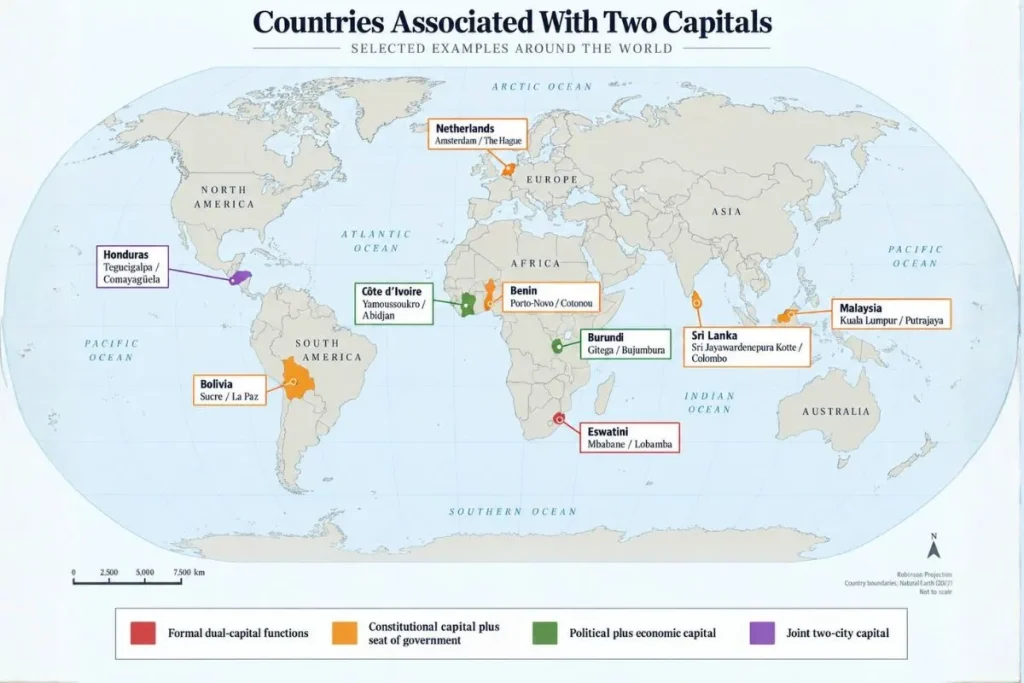
There is no single defensible total unless the definition comes first.
Under a strict legal definition, the list is short because many famous examples actually have one legally designated capital plus another city where government operates.
Under a broader functional definition, more countries qualify because the definition can include administrative capitals, political capitals, government seats and officially described economic capitals.
This article therefore examines nine core current cases rather than claiming that “nine countries officially have two capitals.” Their legal arrangements are too different for that statement to be precise.
A commercial centre is not automatically a capital. Neither is a city a second capital merely because Parliament, a supreme court or several ministries are located there.
What Does “Two Capitals” Actually Mean?
An official or constitutional capital is a city whose national status is established through constitutional, statutory or explicit official terminology.
An administrative capital is where central administration is concentrated. It may be the country’s formal capital, or it may be separate from it.
A legislative capital is a term sometimes applied to a city containing the national legislature. The presence of Parliament alone, however, does not necessarily give the city legal capital status.
A judicial capital generally describes a city containing important national courts. Again, court location and capital status are separate questions.
A royal capital can be a centre of monarchy and ceremony without necessarily being the sole administrative centre.
A seat of government is where the executive and major institutions actually operate. A seat of government can differ from the legally designated capital.
Finally, an economic or commercial capital describes national economic importance. Unless national law or official terminology gives that label a particular status, it should not be treated as equivalent to the country’s political capital.
These distinctions explain most apparent disagreements between lists of countries with two capitals.
Countries Most Closely Associated With Two Capitals
1. Eswatini: Mbabane and Lobamba
Eswatini provides one of the strongest examples of national functions being formally divided between two capital centres.
Mbabane is the administrative centre and the city most closely associated with the day-to-day machinery of government. Lobamba contains Parliament and is central to the monarchy and national ceremonial life. United Nations country information distinguishes Mbabane as the administrative capital and Lobamba as the legislative capital. Eswatini’s Parliament is located in Lobamba.
That makes Eswatini substantially different from countries where a second city merely contains several ministries or an important court.
Best classification: administrative capital + legislative/royal capital.
2. Bolivia: Sucre and La Paz
Bolivia is probably the best-known example of the difference between a constitutional capital and a seat of government.
Article 6 of Bolivia’s Constitution states that Sucre is the capital of Bolivia. The country’s Supreme Tribunal of Justice is also based there.
La Paz, however, is where the executive and national legislature operate. The present arrangement grew out of the political struggles of the late nineteenth century, particularly the Federal War, after which the principal seat of government shifted to La Paz while Sucre retained constitutional capital status.
Calling Bolivia a country with “two capitals” is therefore understandable in functional geography, but describing La Paz as a second constitutional capital would be inaccurate.
La Paz’s unusual elevation also explains why it commonly appears in discussions of the highest capital cities in the world, although technically it is Bolivia’s seat of government rather than the constitutionally named capital.
Best classification: constitutional capital + seat of government.
3. Netherlands: Amsterdam and The Hague
The Netherlands is another case where casual shorthand obscures the legal situation.
The Dutch Constitution refers explicitly to Amsterdam as the capital. The Hague, meanwhile, is the traditional seat of the national government. Parliament, ministries and major national institutions are concentrated there. Dutch government material describes Amsterdam as the nation’s capital and The Hague as the seat of government.
The Hague’s institutional importance is so great that describing Amsterdam and The Hague as the country’s “two capitals” is convenient in ordinary conversation. Legally, however, it is more precise to say that the Netherlands has a capital and a separate seat of government.
Best classification: national capital + seat of government.
4. Malaysia: Kuala Lumpur and Putrajaya
Malaysia is frequently described as having two capitals, but official terminology points to a more precise formulation.
Putrajaya’s own government planning material states that Kuala Lumpur remains Malaysia’s national capital city, while Putrajaya functions as the Federal Government Administrative Centre. The transfer was intended in part to relieve pressure on Kuala Lumpur.
Much of the federal executive administration is now in Putrajaya. Malaysia’s highest judicial administration is also based at the Palace of Justice there. Parliament, however, remains in Kuala Lumpur.
Putrajaya is consequently important enough to appear on almost every “two capitals” list, but calling it Malaysia’s second legal national capital goes beyond the government’s own terminology.
Best classification: national capital + federal administrative centre.
5. Sri Lanka: Sri Jayawardenepura Kotte and Colombo
Sri Lanka’s terminology is different again.
Current Sri Lankan government information identifies Sri Jayawardenepura Kotte as the capital and Colombo as the commercial capital. The national Parliament is located at Sri Jayawardenepura Kotte.
Colombo remains the country’s dominant commercial city and continues to contain important national institutions. Its importance explains why many references describe Sri Lanka as having two capitals.
That description can be useful as shorthand, but the governmental labels themselves show why the cities should not simply be presented as two interchangeable political capitals.
Best classification: national/administrative capital + commercial capital.
6. Benin: Porto-Novo and Cotonou
Benin illustrates particularly clearly why capital and government seat should be separated.
Benin’s National Assembly describes Porto-Novo as the constitutional capital, and Parliament sits there. Official government planning documents also recognize Porto-Novo’s formal political-capital status.
In practice, Cotonou contains the seat of government and many of the country’s most important executive institutions. Official Beninese documentation explicitly places the seat of government in Cotonou.
Benin therefore belongs in a two-city comparison, but not because it has two constitutionally equivalent capitals.
Best classification: constitutional capital + seat of government.
7. Burundi: Gitega and Bujumbura
Burundi changed its capital arrangement in 2019.
Legislation adopted that year established Gitega as the political capital and Bujumbura as the economic capital. Burundi’s presidency records the promulgation of the law formally establishing those two designations.
The wording matters. Bujumbura’s status as an economic capital does not mean it shares the same governmental function as Gitega.
Burundi can therefore legitimately appear in a broader list of countries officially using two different capital labels, but it should not be described as if two cities exercise identical national political authority.
Best classification: political capital + economic capital.
8. Côte d’Ivoire: Yamoussoukro and Abidjan
Côte d’Ivoire officially distinguishes between Yamoussoukro and Abidjan.
Government sources describe Yamoussoukro as the political and administrative capital and Abidjan as the economic capital. Yamoussoukro acquired formal capital status in 1983.
Practical geography complicates that clean description. Abidjan remains the country’s overwhelmingly dominant metropolis and continues to contain important administrative, diplomatic and governmental activity. Official state documentation has itself acknowledged the difference between Yamoussoukro’s formal designation and Abidjan’s continuing practical importance.
The result is another case where two cities have nationally recognized roles but should not be described as equivalent constitutional capitals.
Best classification: political/administrative capital + economic capital.
9. Honduras: Tegucigalpa and Comayagüela
Honduras is the case most likely to be distorted by a simple list.
Article 8 of the Honduran Constitution states that the cities of Tegucigalpa and Comayagüela, jointly, constitute the capital of the Republic.
That is not the same structure seen in Bolivia or the Netherlands. Honduras does not merely preserve one legal capital while government operates in a second distant city. Two adjoining urban areas jointly form the country’s capital.
For that reason, saying Honduras “has two capitals” can itself be misleading. It is more accurate to say that its constitution defines a single national capital composed jointly of Tegucigalpa and Comayagüela.
Best classification: joint two-city national capital.
Countries Often Said to Have Two Capitals but Need Qualification
1. Tanzania: Dodoma and Dar es Salaam
Tanzania is still included in many dual-capital lists because the relocation from Dar es Salaam to Dodoma took decades.
Legally, however, the Dodoma Capital City Act declares Dodoma the capital of the United Republic of Tanzania. More recent institutional reporting describes the government transfer as having advanced through the relocation of central government functions and the State House.
Dar es Salaam remains Tanzania’s dominant commercial metropolis, but that no longer makes it a convincing second national capital under a current strict definition.
2. Chile: Santiago and Valparaíso
Chile is sometimes called a two-capital country because the National Congress meets in Valparaíso.
Law No. 18,678 explicitly establishes Valparaíso as the seat of Congress. It does not, however, designate Valparaíso as another national capital.
A legislature operating outside the main capital is evidence of geographical decentralization, not automatically evidence of a dual-capital system.
3. Montenegro: Podgorica and Cetinje
Montenegro’s Constitution makes an unusually useful distinction.
It identifies Podgorica as the capital and Cetinje as the Old Royal Capital. Government documentation likewise notes that Podgorica is the administrative centre while important historic and state institutions remain in Cetinje.
Cetinje’s constitutional title is significant, but “Old Royal Capital” is not synonymous with a second equal national capital.
4. South Korea: Seoul and Sejong
South Korea has shifted a large part of central administration to Sejong.
The Government Complex Sejong contains numerous central government agencies and was explicitly created as an administrative centre. Seoul nevertheless remains the national capital.
Sejong is therefore a strong example of administrative decentralization, but not straightforward evidence that South Korea has two legally equal capitals.
5. Indonesia: Jakarta and Nusantara
Indonesia is particularly important because its situation is still transitional.
The law creating Nusantara establishes the legal framework for a new national capital, but the formal transfer of Jakarta’s capital functions depends on a Presidential Decree. In May and June 2026, Indonesia’s Constitutional Court noted that this decree had not yet been issued and that the legal transfer had therefore not been completed.
As of September 2026, Indonesia should consequently be treated as a capital-relocation transition, not casually added to a settled list of countries with two capitals.
Why Do Some Countries Have Two Capitals?
Two-city arrangements usually emerge from history rather than from a single model of government.
Bolivia’s division reflects nineteenth-century regional political conflict and the retention of Sucre’s constitutional status after executive and legislative power shifted to La Paz.
The Netherlands preserved Amsterdam as the capital while The Hague continued its longstanding role as the centre of government.
Malaysia deliberately developed Putrajaya as a planned federal administrative centre, allowing Kuala Lumpur to remain the national capital while government administration moved to a purpose-built city.
Benin and Côte d’Ivoire illustrate another pattern: a formal capital can coexist with an older and economically dominant metropolis where major institutions remain concentrated.
Burundi’s 2019 arrangement explicitly separates political and economic roles.
Capital geography can therefore reflect historical compromise, decentralization, congestion, regional balance, monarchy, administrative planning or the incomplete relocation of national institutions.
Official Capital vs Seat of Government
A capital and a seat of government answer two different questions.
The capital is the city formally or officially designated as holding national capital status. The seat of government is where the executive and much of the machinery of government actually operate.
They are often the same place, but they do not have to be.
Bolivia demonstrates the distinction clearly: Sucre is constitutionally the capital, while La Paz hosts the executive and legislature.
The Netherlands has Amsterdam as its capital and The Hague as its seat of government.
Benin recognizes Porto-Novo as its constitutional capital while the government sits primarily in Cotonou.
Malaysia still calls Kuala Lumpur the national capital even though federal administration is concentrated in Putrajaya.
Treating every seat of government as a second official capital removes an important legal and geographic distinction.
Does Any Country Have Three Capitals?
Yes. South Africa is the best-known current example.
South African government sources identify Pretoria as the administrative capital, Cape Town as the legislative capital and Bloemfontein as the judicial capital.
South Africa therefore should not be placed in the core list for an article specifically about two capitals. Readers interested in arrangements involving two, three or more national centres can instead see GeographicTravels’ broader guide to countries with multiple capitals.
Which Countries Have Two Official Capitals?
The answer depends on how narrowly “official capitals” is defined.
Eswatini is one of the strongest cases for two recognized capital functions, with Mbabane associated with administration and Lobamba with legislative and royal functions.
Burundi officially uses two capital labels, but differentiates them as political Gitega and economic Bujumbura.
Côte d’Ivoire likewise officially distinguishes political and administrative Yamoussoukro from economic Abidjan.
Other familiar examples are structurally different. Bolivia has one constitutionally named capital plus a separate government seat. The Netherlands has a capital plus a seat of government. Malaysia has a national capital plus a federal administrative centre.
Honduras is different again: its constitution says Tegucigalpa and Comayagüela jointly constitute one capital.
That is why a source claiming a single exact number of “countries with two official capitals” should also explain the definition it used.
Why Different Sources Give Different Lists
Different lists rarely disagree only about geography. They usually disagree about terminology.
One source may count any city containing the legislature. Another may require constitutional capital status. A third may include officially described economic capitals.
Historic transitions add another problem. Cities can retain ministries, embassies or commercial dominance long after a new capital is legally designated.
Relocations can also take decades, as Tanzania demonstrates, while Indonesia shows how a country can legally create a future capital before the formal transfer itself occurs.
The most useful approach is therefore not to ask only, “Is this city a capital?” It is to ask:
- What does the constitution or law call it?
- Where does the executive sit?
- Where does Parliament sit?
- Does the government itself call another city a capital?
- Is “economic capital” a formal designation or simply common shorthand?
- Is the arrangement current?
Those questions produce a more accurate map of national power than a flat list.
The Bottom Line
Countries described as having two capitals do not share one legal model.
Eswatini genuinely divides major capital functions between Mbabane and Lobamba. Bolivia and the Netherlands preserve formal capitals while government operates largely elsewhere. Malaysia separates the national capital from a federal administrative centre. Burundi and Côte d’Ivoire distinguish political from economic capitals. Honduras constitutionally joins two neighbouring cities into one capital.
The exact total therefore depends on what capital means. A precise geography reference should identify each city’s legal and governmental role first and count it second.
Frequently Asked Questions
There is no universally accepted number because countries divide national functions in different ways. This guide examines nine major current two-city arrangements, but they include genuine dual-capital systems, constitutional capitals with separate government seats, political/economic capital pairs and Honduras’s unusual joint-city capital.
Eswatini is among the clearest examples. Mbabane serves as the administrative capital, while Lobamba performs legislative and royal functions. UN sources explicitly distinguish the two roles.
Sucre remains Bolivia’s constitutional capital, while La Paz became the seat of the executive and legislature after the political conflicts of the late nineteenth century. The arrangement therefore preserves Sucre’s formal status while much national political power operates from La Paz.
Legally, Sucre is the capital of Bolivia. Article 6 of the Constitution says so explicitly. La Paz is the seat of national government and contains the executive and legislature.
Not in the strict legal sense. Amsterdam is the capital, while The Hague is the seat of government and contains Parliament and major national institutions.
Malaysia is better described as having a national capital and a separate federal administrative centre. Kuala Lumpur remains the national capital, while Putrajaya houses much of the federal administration.
Mbabane is the administrative capital, while Lobamba serves legislative and royal functions. Parliament is located in Lobamba.
Sri Lankan government sources identify Sri Jayawardenepura Kotte as the capital and Colombo as the commercial capital. The two cities therefore have different national roles rather than being two interchangeable political capitals.
Porto-Novo is Benin’s constitutional capital and hosts the National Assembly, while Cotonou is the practical seat of government and the country’s main economic centre. It is therefore more precise to call the arrangement a constitutional capital plus a separate government seat.
South Africa is conventionally described by its government as having three: Pretoria for administrative functions, Cape Town for legislative functions and Bloemfontein for judicial functions.