

There are 44 landlocked countries under the counting convention used in this guide: 16 in Africa, 14 in Europe, 12 in Asia and two in South America. A landlocked country has no coastline on an ocean or an ocean-connected sea.
Some are tiny states tucked between much larger neighbors. Others, such as Kazakhstan and Mongolia, occupy enormous stretches of continental interior. What connects them is their relationship to the coast, rather than their size, climate or wealth.
The United Nations describes 44 countries as landlocked, including 32 classified as landlocked developing countries. Those two totals describe different groups.
Complete List of Landlocked Countries
The table groups each country once. Countries are listed alphabetically within their continent.
| Continent | Number | Landlocked countries |
| Africa | 16 | Botswana, Burkina Faso, Burundi, Central African Republic, Chad, Eswatini, Ethiopia, Lesotho, Malawi, Mali, Niger, Rwanda, South Sudan, Uganda, Zambia, Zimbabwe |
| Europe | 14 | Andorra, Austria, Belarus, Czechia, Hungary, Liechtenstein, Luxembourg, Moldova, North Macedonia, San Marino, Serbia, Slovakia, Switzerland, Vatican City |
| Asia | 12 | Afghanistan, Armenia, Azerbaijan, Bhutan, Kazakhstan, Kyrgyzstan, Laos, Mongolia, Nepal, Tajikistan, Turkmenistan, Uzbekistan |
| South America | 2 | Bolivia, Paraguay |
North America and Oceania have no landlocked sovereign countries. Antarctica has no sovereign countries to include.
Czechia is also commonly called the Czech Republic. Laos appears in formal UN lists as the Lao People’s Democratic Republic.
How This List Is Counted
The main list includes 43 UN member states plus Vatican City. It excludes dependencies and partially recognized states. Kosovo is geographically landlocked, but its disputed recognition means it is treated separately here. Adding Kosovo to this list would produce 45.
Continental groupings follow the UN statistical placement of Armenia and Azerbaijan in Western Asia and Kazakhstan in Central Asia. These groupings keep the table consistent, but they do not settle every geographical boundary question.
Kazakhstan also appears in our guide to transcontinental countries. The distinction between statistical regions and physical boundaries is explained further in where Europe ends and Asia begins.
What Does Landlocked Mean?
A country is landlocked when its territory lacks a coast on the ocean or a sea connected to it. This definition concerns territorial access, not whether people can eventually travel to a port.
A landlocked country may still have navigable rivers, international shipping connections, large lakes or ports on inland waters. It may also have agreements allowing goods to cross neighboring territory.
Switzerland, for example, can participate in maritime trade without possessing an ocean coastline. The journey simply involves a route through other countries.
Nor does landlocked mean dry. The countries in our separate guide to countries without permanent rivers are classified by their river systems, not by whether their borders reach the sea.
Landlocked Countries by Continent
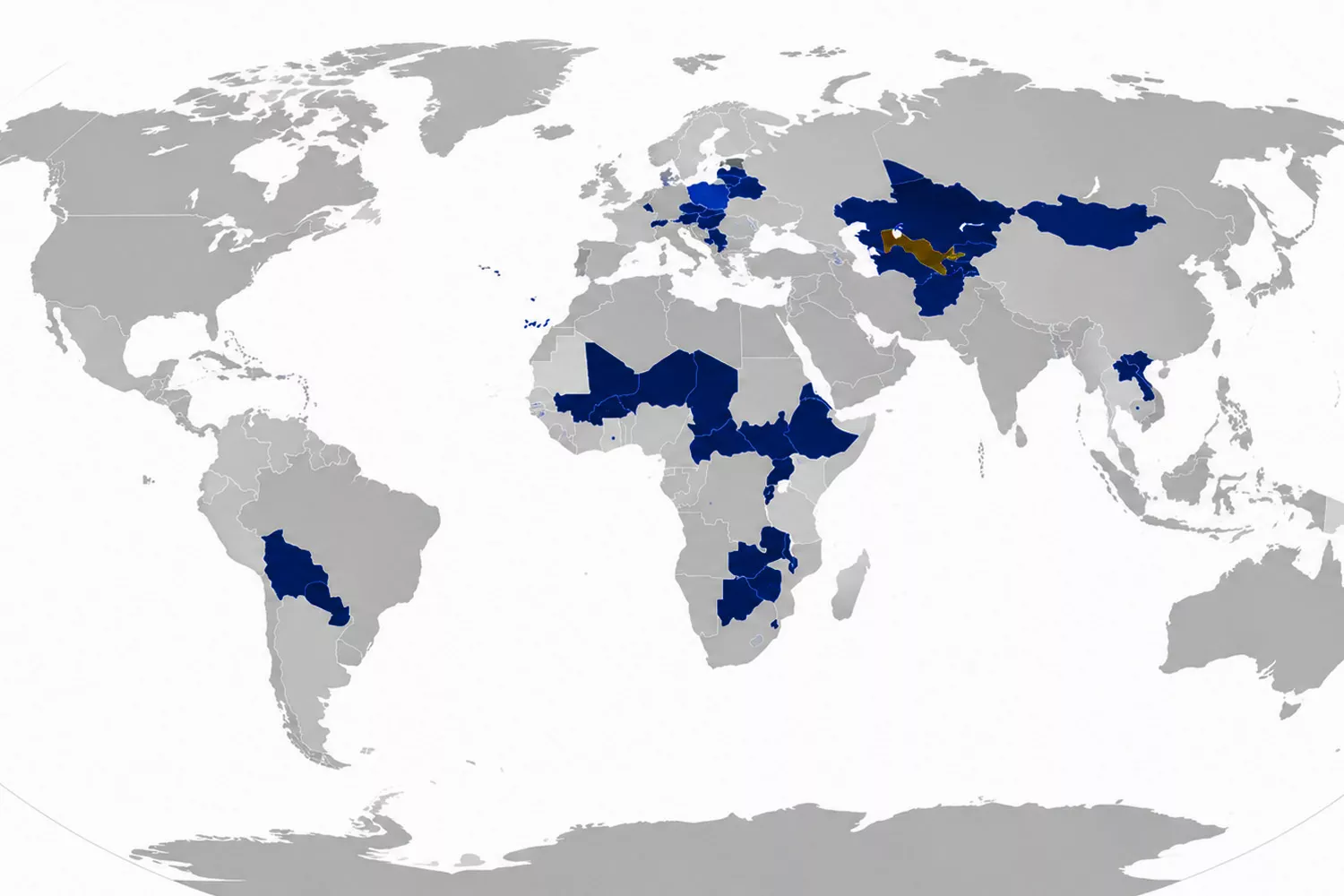
Africa: 16 Countries
Africa has the largest number in this grouping. Its landlocked countries extend across several distinct environments, from the Sahel to the Great Lakes region and southern African plateaus.
Their geography is far from uniform. Chad and Niger include extensive arid landscapes, while Uganda and Malawi have major lake shorelines. Those freshwater shores do not provide a national coastline on an ocean-connected sea.
Lesotho is an especially clear map example: South Africa surrounds it completely. Eswatini is different because it borders both South Africa and Mozambique. Our Eswatini country overview explains its location and national background.
Europe: 14 Countries
Europe has a mixture of small enclosed states and larger inland countries. Vatican City and San Marino are surrounded by Italy, while Austria and Switzerland sit among several neighbors.
Hungary lies in the Carpathian Basin, with the Danube providing an important river connection. Its setting is covered in our Hungary country profile.
The network of major rivers in Europe helps explain how inland places connect with distant coasts. A navigable route to the sea, however, does not turn an inland country into a coastal one.
Asia: 12 Countries
Asian examples range from Himalayan countries such as Bhutan and Nepal to the broad interiors of Mongolia and Central Asia.
Kazakhstan, Azerbaijan and Turkmenistan border the Caspian Sea. They remain landlocked because the Caspian is an enclosed inland body of water, not an ocean-connected sea. Its name can make a simple coastline question unexpectedly confusing.
The regional count also depends on the continental framework. Assigning a transcontinental country to one statistical region prevents it from being counted twice in the global total.
South America: Two Countries
Bolivia and Paraguay are the only landlocked countries in South America. Both depend on routes beyond their own territory for access to ocean ports.
Bolivia also illustrates another distinction worth keeping separate: Sucre is its constitutional capital, while La Paz is the seat of government. Our guide to countries with multiple capitals explains why those roles are not identical.
What Are Doubly Landlocked Countries?
Liechtenstein and Uzbekistan are the two doubly landlocked countries. Every country bordering either of them is itself landlocked. Reaching an ocean-connected coast overland therefore requires crossing at least two international borders.
Liechtenstein borders Austria and Switzerland. Uzbekistan borders Afghanistan, Kazakhstan, Kyrgyzstan, Tajikistan and Turkmenistan.
This is different from being surrounded by a single country. Lesotho is entirely enclosed by South Africa, but South Africa has an ocean coastline, so Lesotho is not doubly landlocked.
What Is the Largest Landlocked Country?
Kazakhstan is the largest landlocked country by area, as the World Bank’s Kazakhstan overview confirms.
Its Caspian shoreline does not change that classification. Access to a large inland waterbody and direct territorial access to the ocean are different things.
Vatican City lies at the opposite end of the size comparison: it is the smallest landlocked country. The contrast shows why landlocked status cannot tell you much about national area by itself.
How Do Landlocked Countries Reach the Sea?
Goods can move by road, railway, navigable river or combinations of these routes before reaching a coastal port. Border procedures, transport infrastructure and cooperation with transit countries affect how practical those journeys are.
The UN overview of landlocked developing countries identifies reliance on transit countries and high trade costs as major development challenges.
However, being landlocked does not automatically mean being poor or isolated. Connections to nearby markets and the reliability of transport networks make an important difference. The geographical condition is shared, but its economic consequences vary.
Frequently Asked Questions
This guide counts 44, including Vatican City and excluding Kosovo from the main total. Including Kosovo produces 45. Check the inclusion rules before comparing lists.
They are usually discussing the UN category of landlocked developing countries, rather than every landlocked country in the world.
It can have a shoreline on a lake or enclosed inland sea. What it lacks is a coast on an ocean or an ocean-connected sea.
No. Most landlocked countries border several neighbors. Being completely surrounded by one country is a more specific geographical arrangement.