

France’s major metropolitan river systems are the Loire, Seine, Rhône, Garonne, Rhine, Meuse and Adour, the seven highlighted by France’s national water information service. Together, their basins cover most of metropolitan France and drain toward the Atlantic Ocean, English Channel, Mediterranean Sea and North Sea.
This guide focuses on metropolitan France. Overseas France has separate river systems, especially in French Guiana, and those rivers are not mixed into the comparisons below. France’s waterways also form part of Europe’s wider river network, so several major rivers begin outside France or continue beyond its borders.
The Loire is the longest river that flows entirely within metropolitan France. The Rhine is longer overall, but only part of its international course is associated with France. Those are different geographical measurements and should not be collapsed into one ranking.
Major Rivers in France at a Glance
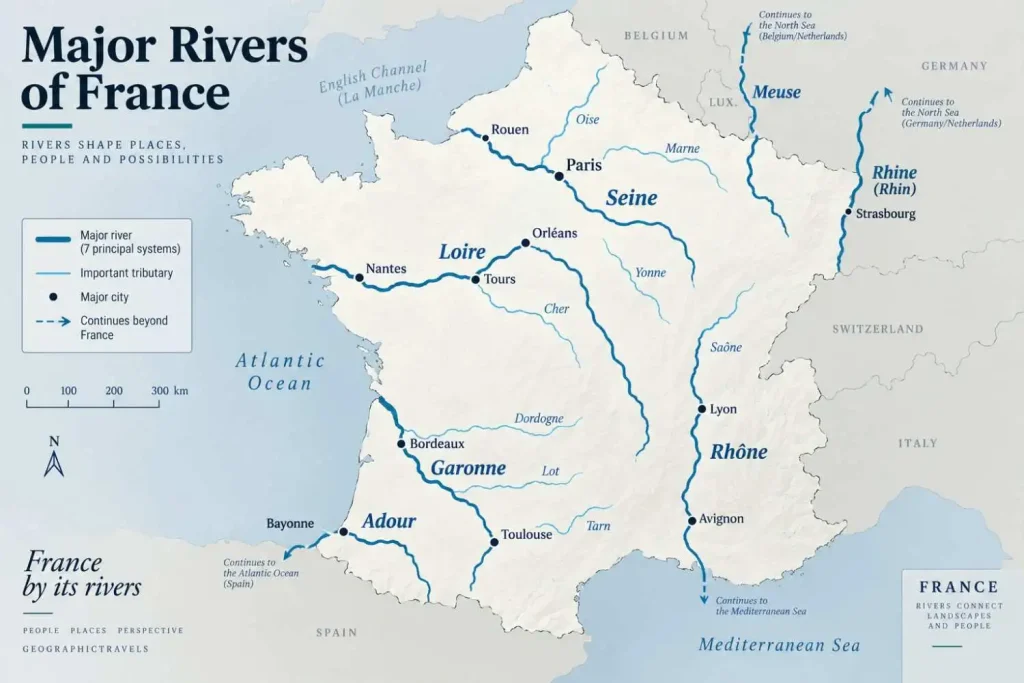
The table uses approximate total river length, not length within France. That distinction matters for the Rhine, Meuse, Rhône and Garonne, all of which are international rivers.
| River | Approx. total length | Main French locations | Immediate or final outlet | Geographic note |
|---|---|---|---|---|
| Loire | 1,012 km | Orléans, Tours, Nantes | Atlantic Ocean near Saint-Nazaire | Longest river wholly within metropolitan France |
| Seine | 776 km | Paris, Rouen | English Channel through the Seine estuary | Entire main course lies in France |
| Rhône | 812 km | Lyon, Valence, Avignon, Arles | Mediterranean Sea through the Camargue delta | Rises in Switzerland |
| Garonne | 647 km | Toulouse, Bordeaux | Gironde estuary, then Atlantic Ocean | Rises in Spain; about 529 km is mapped as the French Garonne course in SANDRE data |
| Rhine / Rhin | 1,233 km | Alsace and the Strasbourg Rhine corridor | North Sea through the Netherlands | International river; part of the Upper Rhine forms the France–Germany boundary |
| Meuse | 905 km | Verdun, Sedan, Charleville-Mézières | North Sea system in the Netherlands | Rises in France, then continues through Belgium and the Netherlands |
| Adour | 307 km | Dax, Bayonne | Bay of Biscay / Atlantic Ocean | Major southwestern French river |
Source note: France’s national water portal provides the seven-system framework and published figures for the Loire, Rhône, Seine and Garonne. The Rhine figure follows the modern international hydrological value of 1,232.7 km, rounded to 1,233 km; the Meuse figure follows the International Meuse Commission; the Adour figure follows the Adour-Garonne water information system. Published river lengths can vary slightly because different sources use different mapping scales, source conventions and endpoints.
What Is the Longest River in France?
Longest River Entirely Within Metropolitan France: The Loire
The Loire is the clearest answer when “longest river in France” means the longest river whose full course lies within metropolitan France. France’s national water portal gives it a length of 1,012 kilometers.
Some widely used references give a figure closer to 1,006 kilometers. That difference is small enough to reflect measurement and mapping conventions rather than a different river. This guide uses the 1,012-kilometer national figure consistently instead of averaging competing values.
Longest International River Associated With France: The Rhine
The Rhine is longer overall than the Loire, but that does not make it the longest river within France. The International Commission for the Hydrology of the Rhine basin gives the main river a total length of 1,232.7 kilometers from its Alpine source system to the North Sea.
France is associated with only part of that international course, principally along the Upper Rhine in Alsace, where the river forms part of the France–Germany boundary. A total international length and a national river reach answer different questions.
Why There Is No Single Useful “Longest French Section” Ranking Here
A separate ranking by length physically within or along France would require a harmonized dataset that treats border reaches, headwaters and estuaries consistently across every international river. That was not established from one current authoritative source during this review.
Rather than combine incompatible national and international figures, this article keeps the distinction simple: Loire for the longest wholly French course; Rhine for the longest full international river associated with France.
What Is the Difference Between a Fleuve and a Rivière?
French geographical usage makes a distinction that English usually does not.
A fleuve is a watercourse that reaches the sea or ocean. A rivière flows into another watercourse instead. In English, both are normally called rivers.
That means the Loire, Seine and Rhône are fleuves. The Marne is a rivière because it joins the Seine. The Saône is a rivière because it joins the Rhône at Lyon. The Allier is a rivière because it joins the Loire.
The distinction is about the downstream destination, not simply size. A tributary can be long and carry substantial water while still being a rivière in French usage.
France’s Seven Major River Systems
Loire
The Loire rises at Mont Gerbier-de-Jonc in the Massif Central before flowing north and then west across France. The Loire-Bretagne Water Agency’s account of the river’s source places its headwaters at Mont Gerbier-de-Jonc and traces the basin toward the Atlantic coast.
Its course connects central and western France through places including Orléans, Tours and Nantes. Major tributaries include the Allier, Cher, Indre and Vienne. Near the coast, the river broadens into an estuarine environment between Nantes and Saint-Nazaire before reaching the Atlantic.
The Loire’s 1,012-kilometer national figure makes it the longest of the major rivers whose entire main course remains within metropolitan France.
Seine
The Seine rises on the Plateau de Langres in northeastern France and follows a broad northwesterly route through the Paris Basin. Paris stands directly on the river, while Rouen lies farther downstream before the Seine reaches its estuary and the English Channel.
The Marne, Yonne and Oise are among its principal tributaries. Their confluences help explain why the river is best understood as a drainage network rather than simply the water visible through central Paris.
The Seine is about 776 kilometers long. Its lower course becomes tidal before the estuary, creating a transition from inland river conditions to the marine influence of the Channel.
Rhône
The Rhône begins in the Swiss Alps, passes through Lake Geneva and enters France downstream of Geneva. A Rhône-Mediterranean basin assessment describes a total river length of about 812 kilometers and roughly 550 kilometers of French course, depending on whether certain engineered or older Rhône channels are followed.
At Lyon, the Saône joins the Rhône. From there the river turns south through the Rhône corridor, passing cities including Valence and Avignon before reaching Arles and the Camargue.
The river ultimately divides across its delta and enters the Mediterranean. Alpine tributaries such as the Isère and Durance add water from the east, while other tributaries arrive from the Massif Central side of the valley.
Garonne
The Garonne rises in the Spanish Pyrenees and enters France before reaching Toulouse. It then crosses southwestern France toward Bordeaux.
Its principal tributaries include the Ariège, Tarn and Lot. The Garonne therefore drains a large area extending from the Pyrenees through the plains of southwestern France.
Bordeaux stands on the Garonne itself, not on the Gironde estuary. The change in name occurs farther downstream, after the Garonne meets the Dordogne near the Bec d’Ambès.
Rhine — Rhin
The Rhine is an international river linking the Alps with the North Sea. It does not begin or end in France.
In France, its most important geographic relationship is with Alsace. The Upper Rhine forms part of the France–Germany boundary, and the Strasbourg metropolitan area is closely tied to the river corridor. The historic center of Strasbourg lies primarily on the Ill and associated waterways rather than on the Rhine’s main channel itself.
The Rhine continues north through Germany and the Netherlands before dividing through its lower delta system toward the North Sea. The Moselle is an important tributary within the wider Rhine basin and carries water from northeastern France toward the main river.
Meuse
The Meuse rises at Pouilly-en-Bassigny in northeastern France. It flows north through places including Verdun, Sedan and Charleville-Mézières before crossing into Belgium and later the Netherlands.
The International Meuse Commission gives the river a source-to-mouth length of about 905 kilometers. Its international route is a useful example of why basin geography and political borders do not align neatly: the river begins in France but most of its downstream journey occurs outside the country.
Its waters ultimately reach the North Sea system in the Netherlands.
Adour
The Adour drains part of southwestern France from the Pyrenean foothills toward the Atlantic. The national Adour-Garonne river database gives the named river a length of about 307 kilometers.
The river crosses the southwest through areas including Dax before reaching Bayonne, where its lower course opens toward the Bay of Biscay. Tributaries such as the Midouze, Arros and Luy help build the wider Adour drainage system.
Its inclusion matters because France’s official national framework counts the Adour among the seven large metropolitan river systems even though it receives less international attention than the Loire, Seine or Rhône.
Important Tributaries and Secondary Rivers
France’s major rivers are easier to understand when their tributaries are grouped by receiving system.
Loire Basin: Allier, Cher and Vienne
The Allier is one of the Loire’s most important upstream tributaries and joins it near Nevers. The Cher follows a separate route across central France before entering the Loire farther west, while the Vienne drains a broad area of west-central France before joining the Loire system downstream.
These rivers help explain why the Loire basin covers far more territory than the main channel alone.
Seine Basin: Marne, Oise and Yonne
The Marne joins the Seine in the Paris region. The Oise enters farther downstream, while the Yonne joins the Seine upstream of Paris.
All three are important to the Seine’s hydrology. Calling Paris simply “a city on the Seine” is geographically correct, but the flow passing through and beyond the capital reflects a much wider tributary network.
Rhône Basin: Saône, Isère and Durance
The Saône joins the Rhône at Lyon and creates one of France’s best-known urban confluences. The Isère carries Alpine water to the Rhône farther south, while the Durance drains a large Alpine and Provençal catchment before entering the lower Rhône.
The Rhône is therefore both an international main river and the receiving channel for several large French tributaries.
Garonne Basin: Tarn and Lot
The Tarn and Lot both join the Garonne from large tributary basins. The Tarn itself receives other rivers, showing how tributary hierarchies can extend several levels upstream.
The Dordogne is handled separately below because its relationship with the Garonne and Gironde is more easily misunderstood than a straightforward tributary connection.
Rhine System: Moselle
The Moselle, or Mosel downstream in Germany, rises in the Vosges and flows through northeastern France before continuing through Luxembourg and Germany to the Rhine at Koblenz.
It is therefore a French river in part, an international river overall, and a tributary rather than an independent sea-flowing main river.
The Garonne, Dordogne and Gironde Explained
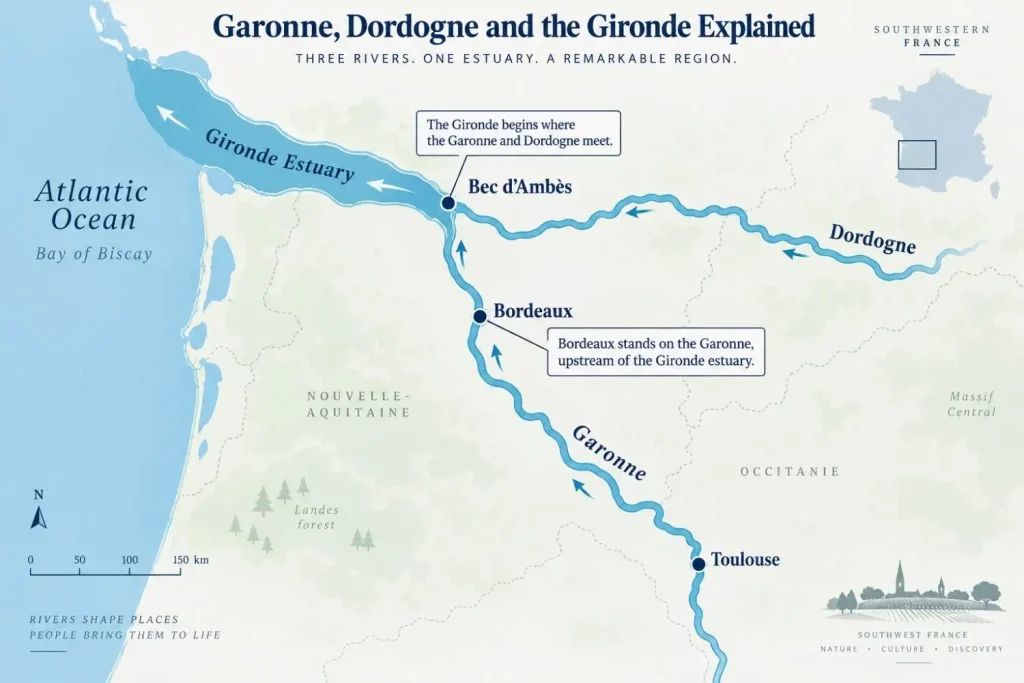
The Garonne, Dordogne and Gironde are related, but the names are not interchangeable.
The Garonne flows through Toulouse and Bordeaux. The Dordogne approaches from the east. Near the Bec d’Ambès, the two watercourses meet and the downstream estuarine water body is called the Gironde.
The Gironde department’s landscape atlas describes the Gironde as beginning at the confluence of the Garonne and Dordogne and extending toward its maritime mouth. The estuary then opens to the Atlantic on the Bay of Biscay coast.
So it is more precise to say that the Garonne reaches the Atlantic through the Gironde estuary than to describe it as flowing directly into the ocean at Bordeaux. Bordeaux is upstream of the Garonne–Dordogne confluence.
Where Do France’s Rivers Drain?
Metropolitan France drains toward several marine outlets rather than one coast.
Atlantic Ocean and Bay of Biscay
The Loire reaches the Atlantic near Saint-Nazaire. The Garonne and Dordogne feed the Gironde estuary before its Atlantic outlet. The Adour reaches the Bay of Biscay near Bayonne.
These systems drain much of western and southwestern metropolitan France.
English Channel
The Seine reaches the English Channel through its broad estuary in Normandy. Several smaller northern and northwestern coastal rivers also drain directly toward the Channel, but they are outside the seven-system framework used for the main article.
Mediterranean Sea
The Rhône is the dominant major system draining metropolitan France toward the Mediterranean. Its basin receives water from the Alps, Jura, Massif Central margins and southeastern lowlands before the river reaches the Camargue delta.
North Sea Through International Rivers
Parts of northeastern France drain toward the North Sea through international systems. The Rhine carries water north through Germany and the Netherlands. The Meuse begins in France but continues through Belgium and the Netherlands before reaching the North Sea system.
Drainage divides separate these basins. The Massif Central, Alps, Pyrenees, Vosges and other uplands help determine whether precipitation ultimately travels toward the Atlantic, Channel, Mediterranean or North Sea.
Rivers Through France’s Major Cities
| City | River or rivers | Geographic note |
|---|---|---|
| Paris | Seine | The main river through the capital |
| Lyon | Rhône and Saône | The Saône joins the Rhône at the southern end of the Presqu’île |
| Bordeaux | Garonne | The Gironde estuary begins farther downstream |
| Toulouse | Garonne | The Garonne crosses the city before continuing northwest |
| Nantes | Loire | Lower Loire city upstream of the estuary toward Saint-Nazaire |
| Orléans | Loire | Major city on the middle Loire |
| Tours | Loire | City on the Loire with the Cher nearby to the south |
| Rouen | Seine | Lower Seine city upstream of the estuary |
| Strasbourg | Ill and Rhine corridor | Historic center lies on the Ill; the Rhine forms the eastern international river corridor |
| Avignon | Rhône | City on the lower Rhône |
| Bayonne | Adour | City near the Adour’s Atlantic outlet |
A city can also belong to a drainage basin without standing on its main river. That distinction is especially useful in complex urban river networks and should not be replaced by a simplified basin-based label.
Why France’s Rivers Matter Geographically
France’s river network helps explain the relationship between uplands, plains, cities and coasts.
The Loire links the Massif Central with the Atlantic lowlands. The Rhône forms a major north-south corridor between Alpine and Mediterranean environments. The Seine organizes much of the Paris Basin, while the Garonne connects the Pyrenees and southwest with the Gironde estuary.
Rivers also influenced where settlements, transport routes and agricultural landscapes developed. Floodplains provide relatively level land and alluvial soils, but they also expose communities to flooding. Navigation has led to channel engineering on some rivers, while dams, embankments and canals have altered natural flow patterns.
Artificial waterways should still be kept separate from natural drainage. A canal can connect navigation routes between basins without changing which sea a natural river would reach under gravity.
The Bottom Line
France’s river geography is best understood as a set of connected drainage systems rather than a list of famous names. The Loire is the longest river wholly within metropolitan France, while the Rhine is longer internationally. The Seine connects the Paris Basin with the English Channel, the Rhône links the Alps with the Mediterranean, and the Garonne reaches the Atlantic through the Gironde estuary.
Keeping total length, French reach, tributaries, estuaries and drainage basins separate makes these relationships much easier to understand.
Frequently Asked Questions
France’s national water information service identifies seven major river systems in metropolitan France: the Adour, Garonne, Loire, Meuse, Rhine, Rhône and Seine. This is a national framework based on major drainage systems, not a claim that France has only seven rivers.
The Loire is the longest river whose entire course lies within metropolitan France, at about 1,012 kilometers in the national Eaufrance table. The Rhine is longer overall at about 1,233 kilometers, but most of its international course lies outside France.
Yes. Using the national figures followed here, the Loire is about 1,012 kilometers long and the Seine about 776 kilometers. Both are sea-flowing fleuves, but they drain different parts of metropolitan France and reach different marine outlets.
Not if the question means the longest river course contained within France. The Rhine is longer than the Loire when its full international course is measured, but only part of the Upper Rhine is associated with French territory. The Loire remains the longest wholly French major river.
The Seine flows through Paris. The wider Seine system also receives major tributaries including the Yonne, Marne and Oise, so the river through the capital is part of a much larger drainage basin extending across northern France.
The Saône meets the Rhône in Lyon at the southern end of the Presqu’île. Downstream of the confluence, the river keeps the name Rhône and continues south toward the Mediterranean Sea.
Bordeaux stands on the Garonne. Downstream of Bordeaux, the Garonne meets the Dordogne near the Bec d’Ambès, where the Gironde estuary begins. The estuary then extends toward the Atlantic coast.
No. The Loire and Adour drain toward the Atlantic, while the Seine reaches the English Channel and the Rhône reaches the Mediterranean. Northeastern parts of France also drain toward the North Sea through international rivers such as the Rhine and Meuse.

